Today’s Document: 1818 Cherokee Agency Payment Record

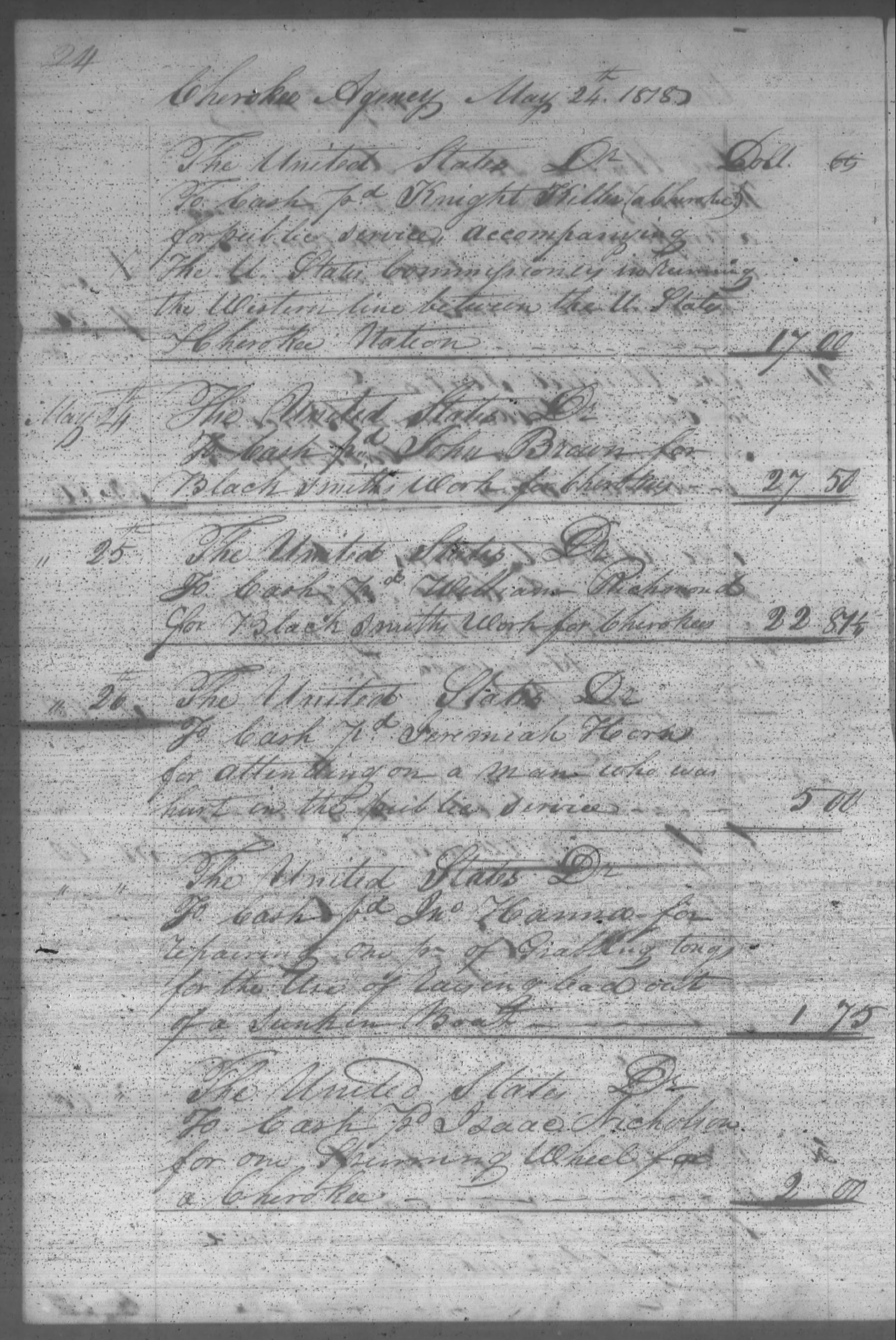
1818 Horn, Jeremiah Cherokee Agency record from May 24

What:  A partial record of payments paid out by the Cherokee Indian Agency.

When:  May 26, 1818.  This was a Tuesday.  Other historical records (Cherokee Council Records) inform us there is a council meeting of the Cherokee chiefs and warriors at the Agency on this day.  This Council began on the 20th of May and would conclude on the 28th.  Governor McMinn revealed to the Cherokee leaders the U.S. government’s’ intent to move all Cherokees west.

Who:  Jeremiah Horn receives a payment from the Agency.

Where:  Agency Creek on the Hiwassee River, Cherokee Nation.  This is the second location of the agency and was located here from 1816 – 1821.  This would be in present day Meigs County, Tennessee named after the agent Return Jonathan Meigs.

Transcription:

” ” 26   The United States ___ To Cash pd Jeremiah Horn for attending on a man who was hurt in the public service.     5.00″

Significance

  1. Confirms Jeremiah Horn’s presence in Cherokee Nation no later than the 26th of May 1818.
  2. Informs how early he may have been aware of the U.S. government’s intent concerning the Cherokee people.
  3. May reveal something about the person Jeremiah Horn.

Questions:

  • Can you fill in the blank in the transcription?
  • What do you believe this document says “about” Jeremiah Horn?

Source:

Citation Information

Detail

Page 27 – Cherokee Indian Agency (TN)

Web Address

https://www.fold3.com/image/205282655/

Source Information

Title

Cherokee Indian Agency (TN) at Fold3

Repository Information

http://www.fold3.com

When Did J.C.W. Ingram Arrive in Texas? And when was the town of Ingram, Texas planted?

“Never let the truth get in the way of a good story”, we’re told.  And, that’s fun.  But, is it what we want our history books and monuments to reflect?  Should we “change” or can we “correct” history?  Is the correction of “facts” changing history or simply aligning our stories with history?

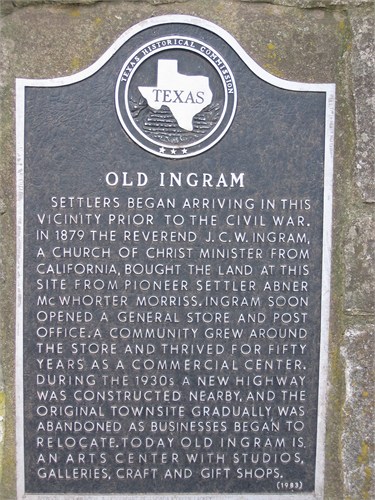
One of my great grandfathers was named John Charles Wesley Ingram.  Most of what is written about his arrival in Texas is wrong.  Three quick examples repeated with small variances in many different sources illustrate what I mean.Ingram historical marker

The photo is one of the historical markers in old downtown Ingram, Texas.  The site is visited by thousands of tourists every year.  It says my great grandfather J.C.W. Ingram bought land on this sight in 1879.  Wrong.  It says he was a Church of Christ Minister.  Wrong.  (My mother was sure he was a Methodist.  I can’t say for certain he wasn’t ever a Methodist.  I know his second wife, my great grandmother Sarah Alice, certainly was a Methodist.  J.C.W. however was a Presbyterian minister…merchant, constable, sheriff, Mason, postmaster, pharmacist, and much, much more.)

Two more examples describe his arrival in Texas.

“In 1879 J. C. W. Ingram bought six acres, in what is now known as Ingram, opened a store and applied for a post office under his name”  (taken from Kerr County, Texas annual budget report 2011-2012 p. 30)

INGRAM, TEXAS. Ingram is on Highway 27 and the Guadalupe River at the confluence of Johnson and Indian creeks, seven miles west of Kerrville in central Kerr County. The surrounding land was granted by the state to John Twohig in 1847. J. C. W. Ingram bought six acres in 1879, opened a store and post office, and gave the town its name.” (From Texas History Online as of August 13, 2015, https://tshaonline.org/handbook/online/articles/hli06 )

Once an event is incorrectly reported, that incorrect report may travel around the world.  Never has this been truer than in the age of the internet.  And we should also remind ourselves that not everything written in books and published is true.

Sometime, somewhere in the last century it was reported that J.C.W. Ingram arrived and bought land in Texas in 1879.  This “fact” is now part of multiple online articles, family trees, newspaper articles, county histories, Texas guidebooks and several expensive historical markers in Kerr County, Texas.  The problem, this “fact” is wrong and to record it as such is inaccurate.

So, can we change or correct history?

History may be seen in 3 ways:

  1. Events which have taken place in the past.
  2. The stories (oral history) or recordings (written history) of those past events, accurate or inaccurate.
  3. His/Her-story. How an individual chooses to research, hear and interpret available “facts” concerning an event in the past and report those “facts” to others.

I visited Kerr County in the spring of 2013 with by wife, brother and sister-in-law.   We were looking for land and marriage records…and of course, antiquing.  We were fortunate to meet Irene Van Winkle of the West Kerr Current newspaper.  She was surprised and concerned, as any conscientious reporter would be, of a possible error in the dates for the Ingram’s arrival in Texas.  She had reported this erroneous “fact” more than once herself.  I shared with her my concerns and she expressed her intent to look into the matter.

Here are some facts I’ve found related to J.C.W.’s arrival in Texas.

  1. According to the Pacific Rural Press of California dated May 17, 1879, J.C.W. Ingram is elected as an officer of the Lakeport Grange Hall #76.
  2. J.C.W. Ingram was a well-known, well respected and well-to-do man living in Lake County, California during the middle part of the 1800s. There are many records to illustrate these facts.  For now, I’ll refer you to a biographical sketch of Ingram found in the “History of Napa and Lake Counties, California: Comprising Their Geography, Geology, Topography, Climatography, Springs and Timber” written by Lyman L. Palmer, A.M., Historian and published by Slocum, Bowen and Co. of San Francisco, California in 1881.  The digital copy in my possession is a photocopy of a first edition donated to Harvard College Library.  Palmer signs the preface to his book in November of 1881.  The Ingram sketch beginning on page 250 closes with the mention or six surviving children; Luella C., John L., Mary R., Sarah A., Ruth and Maud.  The article ends with the Ingram’s loss of two sons; William R. and Preston.
  3. According to cemetery records William Riley Ingram died in Lake County on November 30, 1878. He’s buried in the Hartley Cemetery which began in 1860 as a Masonic Cemetery.  J.C.W. once served as Worshipful Master of this Lodge #199.  I include this because it is a sequence of events happening prior to the Ingram’s leaving for Texas.
  4. According to the 1880 Federal Census, John C.W. Ingram is a 51 year old farmer living in Scotts Valley Precinct and Big Valley Township. In his household is Mandana A., 46; John L., 17; Mary R., 14; Sarah A., 11; Ruth, 8; Maud, 6; Laura A., 24 (We know this to be the widow of William Riley); Arthur O. Lillie, 4 (a son widow Laura brought into her marriage with William) and Ethel Ingram, 11 months (Laura and William’s daughter).  Enumerated 21st day of June 1880.
  5. This same John C.W. Ingram has his farm enumerated with the following facts recorded on 21st day of June 1880 reporting his production for the year of 1879 in Scotts Valley, Big Valley Township of Lake County, California. Acres of land: 140 tilled, fallow or in rotation.  6 acres meadows, pastures, orchards or vineyards.  105 acres woodland or forest.  Farm values: $8,000.00 for farm including buildings, land and fences.  $150.00 for farm implements and machinery.   Value of livestock, $300.00.  Cost of building or repairing fences in 1879, $350.00.  Amount paid for wages in 1879, $500.00.  Weeks hired laborers in 1879, 52 weeks.  Estimated value of all farm production for 1879, $1,200.00.  Acreage mown in 1879, 10 acres.  Acres not mown, 230 ac.  Products harvest in 1879, 20 tons of hay.  Horses on hand as of June 1, 1880, 7 horses.  Mules on hand as of June 1, 1880, 1 mule.
  6. In the precinct of Lakeport, in the county of Lake, CA, several miles to the southeast of the Ingram farm, John F. Burger is enumerated in the 1880 census 18th of June. Included in his household is his 25 year old son, George F. Burger.  According to the Ag schedule for this farm (1880 Federal) it is larger but valued just over half of the Ingram’s place.
  7. In the 1900 census Mary R. Burger, age 34, is living with her husband George F. Burger, her children (6) and George’s Brother James C. Burger in Township 4, Lake County, CA. Mary and George are reported to have married in 1881 and have thus been married 19 years.  Mary was born in California.  Her father was born in Illinois and her mother in Missouri.  (Mary Rebecca Ingram married George F. Burger in Lake County, CA on 7 December 1881.)
  8. Mary Rebecca Ingram Burger was the great grandmother of Kathy Fuqua Rivas. According to an Ancestry.com message I received from Kathy on March 15, 2015, her relative Gene Burger was still running the original Ingram place until his death in 1978.  His son Fred took over upon his death and the farm was only recently sold within the past 10 years, thus leaving Burger ownership for the first time since the 1880s.  This was the former ranch of J.C.W. Ingram which he sold before leaving for Texas.  (p. 11 of Scottslandia: A Romantic History of Scotts Valley by Alice W. Deacon)

In 1881 J.C.W.

“…sold all of the rest of his land to John F. Burger, and left right away for Texas.  The night before the Ingram family left the Valley, his daughter Mary was married to Fred Burger, son of John F. Burger, and the young couple built themselves a home nearby.”

(Scottslandia: A Romantic History of Scotts Valley by Alice W. Deacon, p. 30)

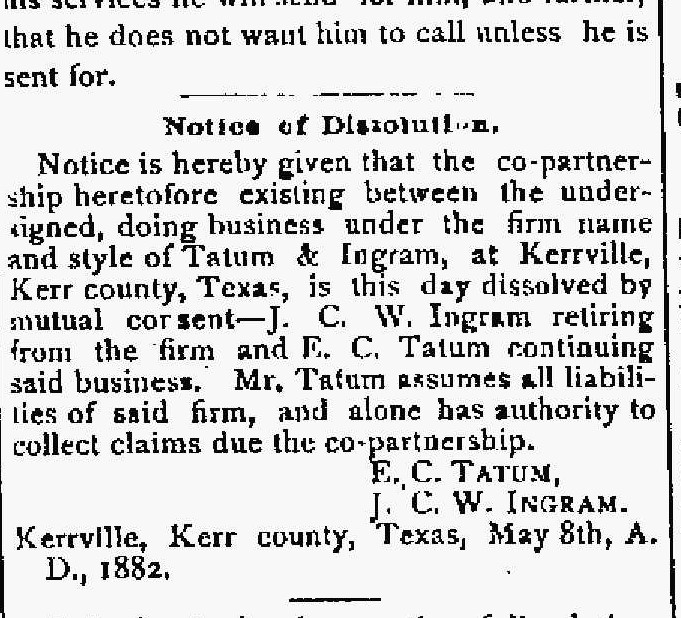
  1. In the May 11, 1882 edition of the San Antonio Evening Light there is an announcement of a business dissolution.  J.C.W. Ingram of Kerrville, Kerr County, Texas dissolves all business ties with E.C. Tatum as of May 8, 1882.   Mr. Tatum assumes all liabilities of the firm, and alone has authority to collect claims due the co-partnership.
  2. According to the research in Jim Wheat’s POSTMASTERS & POST OFFICES OF TEXAS, 1846 – 1930 (http://www.rootsweb.ancestry.com/~txpost/postmasters.html), John C.W. Ingram became Ingram, Texas’ first postmaster on October 31, 1882. According to The Official Record of the United States Vol 2, containing a list of the officers and employees in the Civil, Military and Naval Service on the first of July 1883, J.C.W. Ingram is the postmaster of Ingram in Kerr County, Texas.
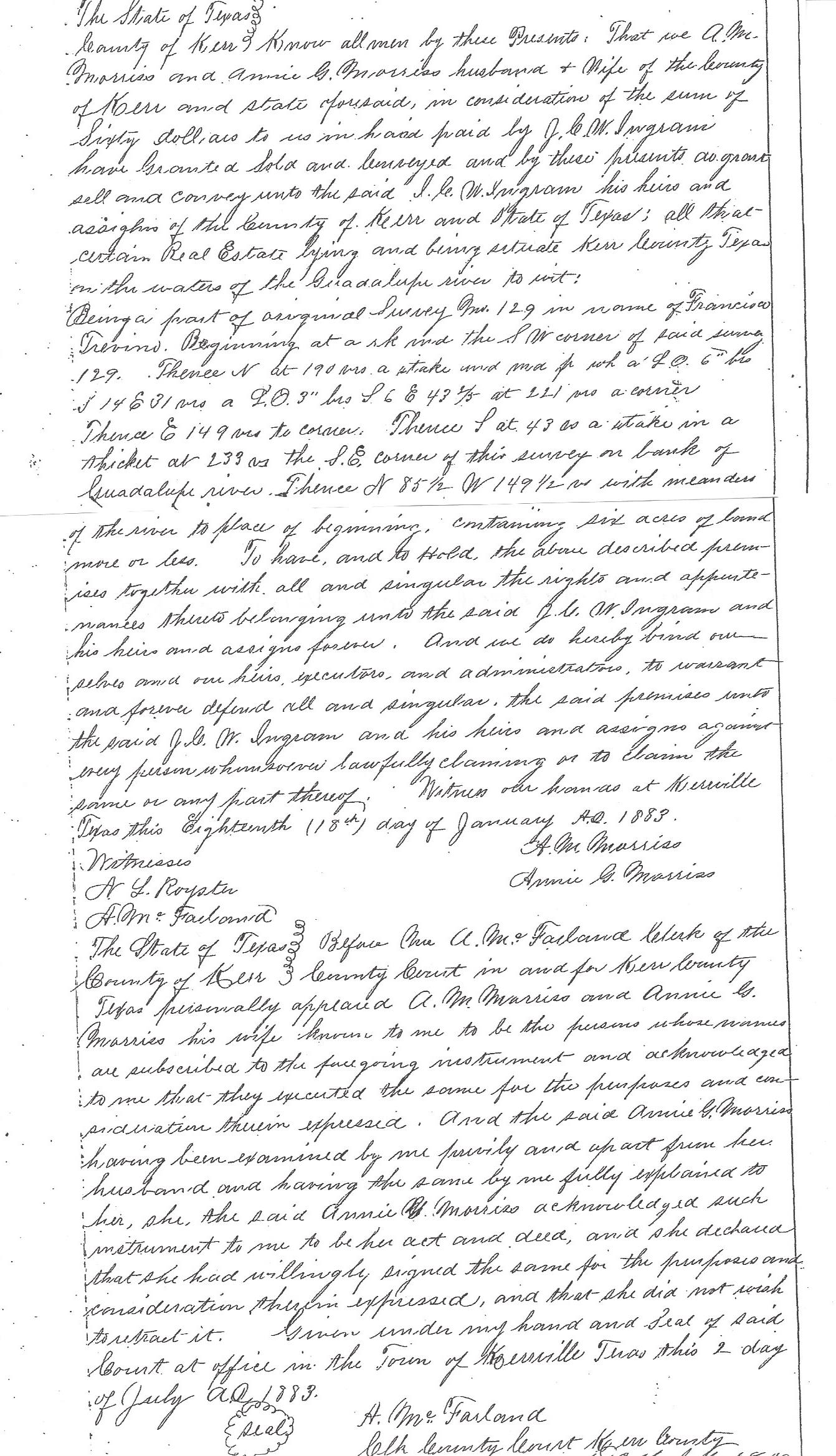
  3. Deed records copied from the courthouse records in Kerrville, Texas in May of 2013 tell us J.C.W. Ingram bought lots from C.E. Mitzschke in Kerrville in February of 1882 (Vol G p. 71). This is not the land he will later purchase west of town.  The land he purchased from the Morriss family on which he built his store and ran his post office on the Guadalupe River was purchased in January 1883 (Vol H pp 8, 9).
  4. The August 27, 1883 edition of the San Antonio Light newspaper has this item in the Hotels report: “J.C.W. Ingram and Frank Coleman, prominent citizens of Kerrville, are at the Central”. (Notice the phrase “of Kerrville”.) He had stayed previously at the same hotel in June of the same year.

How we interpret and report these facts will determine how close our story is to history.  What may we learn from these facts about J.C.W. Ingram’s arrival in Texas?

Observations:

The facts not only give evidence the Ingrams were NOT in Texas in 1879, they also imply he was not even thinking of coming to Texas until as late as 1881.

  • J.C.W. accepted a new office and responsibility in Lakeport, CA in May of 1879.
  • J.C.W. is the head of a household in Scotts Valley, CA in June of 1880. He can’t be in two places.
  • J.C.W. reported in June of 1880 he spent $350.00 in 1879 on his fences. He spent $500.00 on labor.  He reports only having 7 horses, 1 mule and no other livestock requiring fencing.  That’s a very large financial outlay.  It’s over 10% or the total value of his property, buildings, crops and farm implements!  That kind of investment does not indicate to me he’s planning to sell his place.  It’s already prime real-estate.  If you’re planning on leaving the state, let the new owner invest in his own fences and oversee the labor.
  • The biographical sketch of J.C.W. mentioned earlier was published in 1881. To write this piece it would have been necessary to interview J.C.W. or someone very close to him.  The preface was signed in November 1881.  Harvard College Library obviously received an advanced copy because their copy is stamped with an October 1881 receipt date.  The interview would have been between the death of William in late 1878 and sometime in early 1881.
  • John F. Burger purchases this farm and ranch in the fall of 1881. J.C.W. would need to be in California to oversee this sale.
  • J.C.W. and Mandana’s daughter Mary Rebecca married John F. Burger’s son George Frederick (Fred) on December 7, 1881 and the Ingram family left for Texas the next day. The facts all support this account.    May 11, 1882 Desolution of Tatum and Ingram Partnership
  • J.C.W. is in Texas before May of 1882. We know this because he’s already dissolving a partnership with E.C. Tatum.  This implies he arrived in Texas, agreed to enter a business partnership and arranged an agreed upon dissolution of that partnership all in a few months’ time.  I wonder what happened?  The 1879 San Antonio City Directory lets us know Elisha C. Tatum was a young clerk working for L. Moke & Co. while living in the home of his father.  In the 1880 census he’s 23 and living with his sisters Viana Gillis (widowed or divorced with two children) and Sally Tatum who is 15 and still in school.  His occupation is “clerk”.  In the 1881 San Antonio Directory he’s listed as “E.C. Tatum and Co. (Elisha C. Tatum, Mrs. Viana Gillis), groceries, provisions and proprs Buffalo Camp Yard, 25 and 26 n Flores.  See advr’t.”  Buffalo Camp Yard was a well-known place to gather and move supplies from San Antonio to points west.  There was a regular freight run from the Buffalo Camp Yard through Kerrville and on to Comfort, Texas.  It would have passed near or through the land J.C.W. would eventually purchase on the Guadalupe River.  It may have passed by his property in Kerrville purchased in February 1882.  So, let me speculate.  By early 1882 a young, aspiring business man and his sister need a cash infusion into their grocery and supply business.  Perhaps it was Frank Coleman, the brother-in-law of Elisha Tatum, who introduced Tatum to J.C.W.  Coleman and his wife lived in Precinct 1 of Kerr County (primarily the city of Kerrville) near where J.C.W. bought those lots in February 1882.  He and Coleman are described in the San Antonio newspaper in 1883 as “prominent citizens of Kerrville”.  J.C.W. had plenty of capital to invest and may have been looking to get into business before arriving in Texas.  The young salesman “sold him” and they entered a business agreement.  Something happened.  Perhaps J.C.W. got a clearer picture of the person or the condition of the business.  He appears to have pulled out of the arrangement without recovering his cost or any future income from the business.
  • If one needs a building or a piece of land to have a post office and be the postmaster of the new berg of Ingram, we can say J.C.W. did not own the land now known as Old Ingram until January 1883. He may have owned or invested with his friend Frank Coleman in Kerrville prior to and/or in 1883.  It may have been business or ministry, or I suspect both, but J.C.W and his family began their time on the Guadalupe River in 1883.  So, if you need a property or a building or a post office to have a town and or have it named after you, Ingram was not birthed until 1883.

Unlike most travel guides to this date, Hill County Visitor.com gets it right.

“Ingram, Texas is on the north bank of Guadalupe River. Ingram, Texas was founded 1883 by J.C.W. Ingram who built a store and conducted church services…”

The facts say the Ingrams left California in December 1881.  They were in Texas by February of 1882 and purchased land in Kerrville.  They then purchased the land where old Ingram sits from the Morriss family in January 1883.

Conclusions:

  1. J.C.W Ingram arrived in Texas in early 1882.
  2. The seed for the town of Ingram was planted in 1883.

The On-going Mystery:  WHY did J.C.W Ingram; successful, well respected, settled, choose to pull up stakes in California and move to the Hill Country of Texas?  Was it…

  • Grief over the loss of his sons?
  • The need for a new adventure or challenge?
  • A business opportunity?
  • Church ministry?

Does anyone have a letter from J.C.W. explaining it?  Please feel free to share it here.

1883 Ingram and Morriss land deed Kerr County Deed Book Vol H pp 8,9
1883 Land deed between J.C.W. Ingram and Abner McWhorter & Annie G. Morriss

Backtracking John Rivers Roberts

Some of us are drawn to cemeteries.  I can’t explain it.  Finding the final resting place of our ancestors becomes a quest.  It completes a picture for me.  I want to know where they were born, walk the land they walked and visit the place they were buried.  Strange.  I can’t explain it.  But somehow it connects me.

I’ve “met”, corresponded and visited by phone with a number of Roberts cousins over the past few weeks.  One of the newest ones is Charles Roberts of Calloway County, Kentucky.  He is the 2 x great grandson of Newton T. Roberts, the brother of my 2 x great grandfather John Rivers Roberts.  Charles asked me if I could “shed some light” on where my great great grandfather John Rivers Roberts and his wife Rebecca Ann Giles are buried.  I believe I can (or at least I have an opinion).  Here’s the story.

I grew up knowing little or nothing about the Roberts family except the names of my grandparents Gus and Emma Lee Roberts.  I peppered my dad Burton Lee Roberts with questions as a teenager.  He either couldn’t or wouldn’t tell me what he knew.  I believe he knew little or nothing.  About 30 years ago in the middle of my own growing family and ministry work a couple of college professors, amateur genealogist, shared with me the name and burial place of my great grandfather John A. Roberts.  I did nothing significant with this information until 2012.  Perhaps it was age or opportunity but I’ve always been curious and had to know some answers.

I backtracked the John A. Roberts family to Calloway, Kentucky.  I placed a small ad in the personals section of the Murray Ledger and Times and ran it from Wednesday through Sunday hoping to reach the people who buy the paper for the Thursday ads or Sunday morning paper.  My email address was included in the ad.  On Thursday I received an email from Deborah Outland of Lexington, KY the 3 x great granddaughter of John Rivers Roberts and his first wife Sarah B. Smithson.  Her longtime friend Shirley Parrish had called her and told her about the ad.  Shirley and her husband L.B. Parrish live in Murray.  L.B. had recently had eye surgery and was looking for some small print to test out his “new” eyes.  He read my ad to Shirley and she called Deborah.  We arranged a phone visit (one of several over the past 3 years and she has been so generous with her family knowledge).  Deborah put me in contact with Rudy Holland back in Calloway County.  He’s also the 3 x great grandchild of John Rivers Roberts and Sarah B. Smithson.  Rudy owns his grandfather’s old farm place which I believe sits next to the John Rivers Roberts’ original farm in Calloway.  I believe it was Rudy who shared over the phone with me the name John Rivers Roberts and “sent” me to Williamson County, Tennessee.  In other words, you can’t do good genealogy without a lot of wonderful people’s help!  (Note added 7/30/2015, My “newly discovered” cousin Charles Roberts points out that Rudy Holland was also the 2 x great grandson of Newton Roberts on the Holland side.)

I’ve learned much about the Roberts family since “striking” the trail in 2012.  By 2013 I thought we (my faithful wife and research assistant Dee Ann) had enough information to make a trip to Tennessee and Kentucky.  We picked up the trail in Tennessee a few days after Thanksgiving and enjoyed the end of a weekend of celebrating the anniversary of the Battle of Franklin.  The Carnton Plantation is well worth the visit.

On Monday morning we were in the Williamson County Archives as soon as the considerate and helpful staff opened the doors.  If you’re doing genealogy research for Williamson County ancestors, this is a must visit.  It’s a library, research center and courthouse all rolled into one.  We took pages and pages of document copies away from the center at very reasonable prices.  They have a computer database from which you can search, access and print records.  They have an excellent collection of genealogical volumes for research only purposes.  They have books and collections for purchase.  They have old maps.  And did I mentioned they have informed and helpful staff and volunteers?

I continue to mine the gold and assay the value of the nuggets we unearthed in our visit.  The story of my Roberts family continues to unfold in bits and pieces.  As we assemble the pieces of the puzzle, the picture becomes brighter and more certain.  I’m very interested in any piece you may have to add to the puzzle.

John Rivers Roberts was born October 14, 1800 in probably Lunenburg County, Virginia.  (We hope to pick up the trail there someday soon.)  Family lore says he was named after his father (John) and his mother’s maiden name “Rivers”.  I can’t confirm this.  In fact, I find evidence to the contrary.  However, I never discount family lore until I can completely discredit it.  Even if it’s not true, it often has an element of fact in it.  There is a possibility that our family lore is off by one generation and that it was his grandfather who was married to a Rivers and not his father.  We have yet to confirm the first name of John Rivers’ grandfather but believe we know where to pick up his trail.

Here’s a quick side note for those researching this family.  Pay close attention to allied families and neighbors in both Williamson, TN and Lunenburg, VA.  You will see many of the same names and find where the Roberts children obtain their mates.  Keep in mind that Lunenburg County changes configuration at least 3 times and maybe more during this Roberts family tenure there.  Look at the Roberts and their neighbors on Juniper Creek off of the north branch of the Meherrin River in Lunenburg.  This appears to be the beginning area of our specific Roberts family branch’s multiplication in America.  My candidates for John Rivers’ grandfather include William, Thomas and James.  My leading contender is James, the same name as John Rivers’ older brother who was born in 1798.  Keep in mind as you research that there appears to be two James Roberts on Juniper, Senior and Junior.  It’s possible that one of these is John Rivers father’s dad and the other his brother.  It’s possible that one is his father and the other is his grandfather.  It’s possible this is not the name of John Rivers’ grandfather at all!

We pick up John Rivers Roberts’ trail back in Williamson.  He and his family can be documented by tax records in the county as early as 1805.  Land and legal documents continue to build the picture through the late 1850s.  It appears they had land on the Harpeth River first and then settled for good on the headwaters of McCrory Creek which feeds into the Harpeth south of Franklin.  Besides James (1798), I have been able to identify two more brothers and one sister.  Frances “Fannie” Roberts was born in 1802.  Anderson G. Roberts was born in 1808.  I suspect he is the origin of my great grandfather John Anderson Roberts’ middle name.  Newton T. Roberts was born in 1811.  Some say there was also a Joseph but I haven’t been unable to document this person.  John Roberts Sr. (John Rivers’ father, I call him “My John Roberts”) may have had other brothers migrate to Williamson.  This makes unraveling the Roberts crew in Williamson that much more challenging.  (Hidden away in the woods off Roberts Rd. in Arrington, TN there is a “lost” cemetery known by old timers to be the Benjamin Roberts cemetery.  You find his son John D. in Williamson County documents.  Finding and visiting this cemetery is another story for another time.)

John R. (the name I usually use to identify John Rivers Roberts) married Sarah B. “Sally” Smithson in 1821.  Family lore says she was an exceptionally beautiful young lady.  She came from a large family with a large presence in Lunenburg, Charlotte and Mecklenburg counties of Virginia.  They also had a big presence in Williamson County through the 1800s.  They settled on Rutherford and Flat Creeks in the southern part of the county.  Brothers John R. and Newton would eventually buy land on these same creeks and begin their own families.

John R. and Sally Smithson Roberts welcomed their first child Clement Smithson Roberts in 1822.  He appears to be named after his maternal grandfather Clement S. Smithson.  Their second child was a son as well, they named James in 1825.  Was this in honor of my John Roberts Senior’s father?  I don’t know but it could be a clue.  Sadly, I have reason to believe the arrival of this son coincided with Sally’s death.  John R. now had two young sons to raise on his own.

John R. married his second wife, Rebecca Ann Giles, in January of 1827.  She too came from a large and significant family who lived south of today’s Bethesda, TN.  They obtained their marriage license from Maury County just to the south and east of this location and after marriage settled on Rutherford Creek.  Their children included William Claiborne, 1827, in honor of Rebecca’s father William C. Giles, Sarah “Sally” (1828) in honor of John R’s first wife (*See note below.), John Anderson (1830), Thomas Paschal (1832), and Lucy Jane (1833).  John R’s brother Newton would marry Rebecca Ann’s sister Sarah Jane Giles in 1838.  The brothers buy at least one piece of land together in 1838 on the waters of Rutherford and Flat Creeks.  Newton will eventually sell back his part to this land to John R. in 1849.  I have suspected this was in order to migrate to Calloway County, Kentucky.  But one or more of the cousins points out that Newton “drops off the radar” for 20 years and reappears in Calloway in 1870.  Wow!  Does anyone know where he went?  The year sounds like gold fields in California.  These dates also include the Civil War.  Can we document something?  Is there any family lore on the Newton family side? (*See note below.)

John R and Annie’s boys will all eventually migrate to Calloway.  Most will stay.  My great grandfather John Anderson will be the exception.   He migrates to Texas with his son-in-law J.B. Lassiter and family in about 1875.  John R. is the last of the Roberts from Williamson to arrive in Kentucky.  I suspect because his mother did not die until about 1857 in Williamson.  I failed to mention earlier that his father, John Roberts, died all the way back in November of 1823.  His wife, John R.’s mother, never remarried and lived on the McCrory Creek property until her death.  (Her name was Rebecca Sammons which may come as a surprise to most family tree owners with John Rivers Roberts in their trees.  But this is another story for another day.)  In the 1850 census she’s living on this property with her daughter Fannie (That’s Francis “Fannie” Roberts) and Fannie’s husband Alfred Tatum and their children.  The Tatum family also migrated from Lunenburg, VA and vicinity.  At one point we find Fannie and her family living next door to Anderson G. Roberts in Hickman County, TN in 1840.  He was her younger brother.  He married Alfred Tatum’s sister Celia in 1831.  So brother and sister married brother and sister. The Anderson G. family is back in Williamson County in the 1880 census perhaps living on the original Roberts place after a time in Marshall County, KY.  (Note:  This is where William Penn Roberts once commented he had lost track of them.  I’ll talk more about Penn when I write about Rebecca Sammons)

Now, what was that question?  Oh yeah, can you shed any light on where John Rivers and Rebecca Ann Roberts are buried?  Back on the trail…

Dee and I left Williamson County headed for Calloway in early December.  We had pre-scheduled visits to the courthouse in Murray and the Pogue Special Collections Library on the campus of Murray State University.  We had also arranged to meet with Rudy Roberts Holland and tour the Liberty/Shiloh area.  Only our visit with Nancy Roberts Thurman did not go as planned because of an illness in her family.

Rudy Holland is everything you would expect to find in a Kentucky gentleman.  He was warm and gracious, informed and helpful.  He shared family group sheets and a copy of his GEDCOM file he had on disc.  He allowed me to copy (I photographed) his Roberts family binder.  A few years ago Rudy had an old log cabin he was told John R. had built over 150 years ago moved up behind his farmhouse.  Rudy built a cedar exterior around it to protect it from the elements.  What a wonderful experience!  What a wonderful Roberts’ family treasure!  Then we were off to the cemeteries where we visited my great-grand-aunts and uncles’ final resting places.  There were plenty of cousins as well.  But what about John Rivers and Rebecca Ann Roberts place of rest?

I first read about this mythical cemetery on internet inquiry sites.  I saw mention of it in the Pogue Library.  It was called Roberts Cemetery #2.  Some of my cousins had heard of it and thought they might know where it was but had only visited as small children or had it pointed out to them at a distance.  Based on some of this information, I had previously found a map on the website Podunk and then used Google Earth software to locate what I thought was a contender.  I was wrong.  It turned out that I was looking at the Clement Smithson Roberts Cemetery.  Now, that was a fascinating visit in itself!  But…

Where was John R. and Rebecca Roberts?

John R. and Rebecca bought a farm in the Shiloh community Calloway prior to 1860.  They’re working the farm with a young John Childers whose family they knew in the area.  The farms adjacent to theirs are owned by the Hollands, Roberts (W.C. and T.P.) and Ivies.  By the 1880 census Rebecca is deceased and John R. has married his neighbor Malinda Holland.  Her maiden name was Miller.  She married Josiah Holland in January of 1843 and he died in 1862.  By 1880 she and their youngest son Henry B. Holland are living in the John R. Roberts household.  Without an 1870 census for this same Roberts household I can’t be any more accurate on death dates (at least not yet).  Rebecca died sometime after 1860 and John R. died sometime after 1880.  I’m hoping someone has more information than this.  Who knows, I may have it buried in a document I possess and have overlooked it.

The burial place.JRR 3

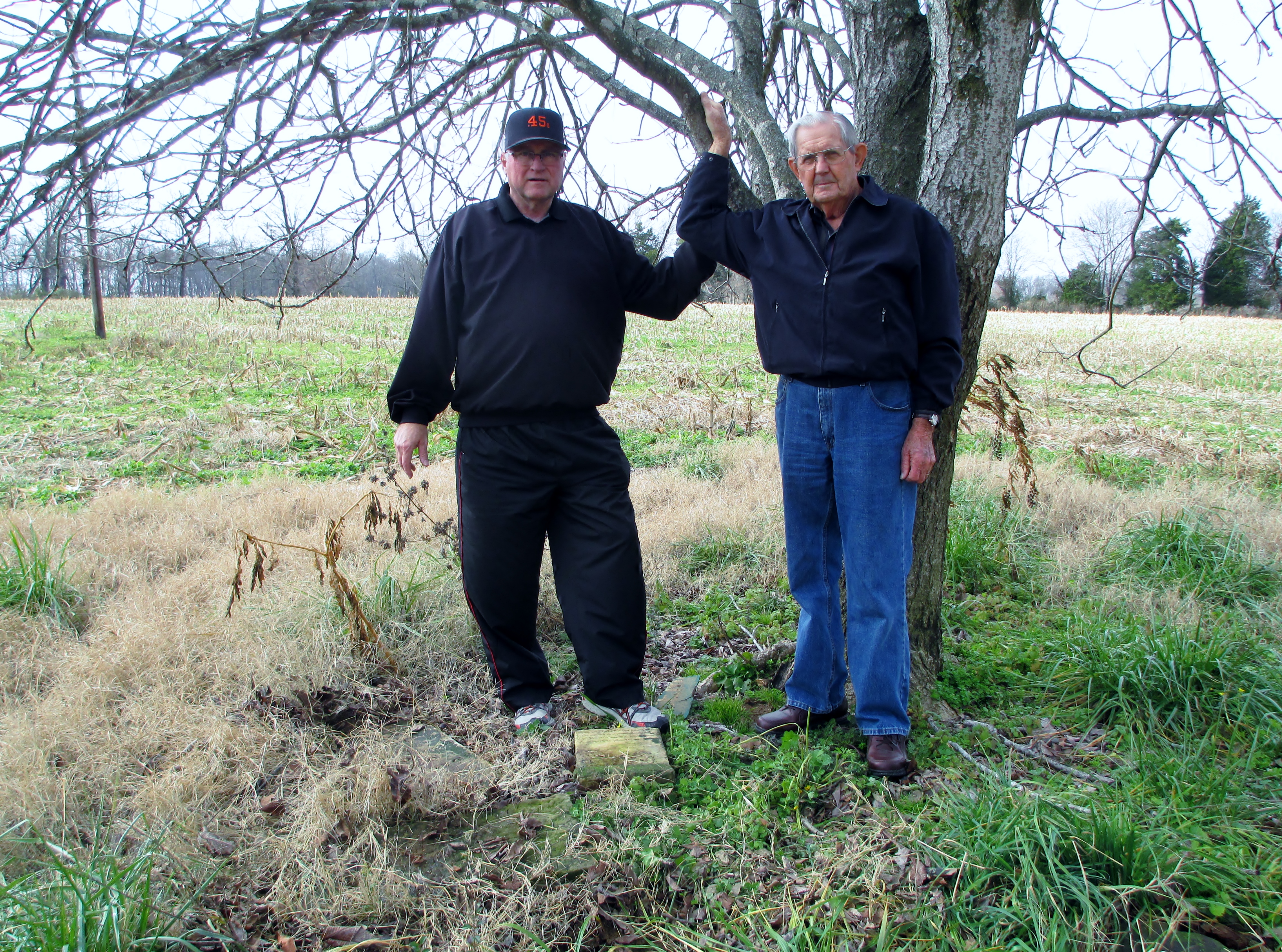
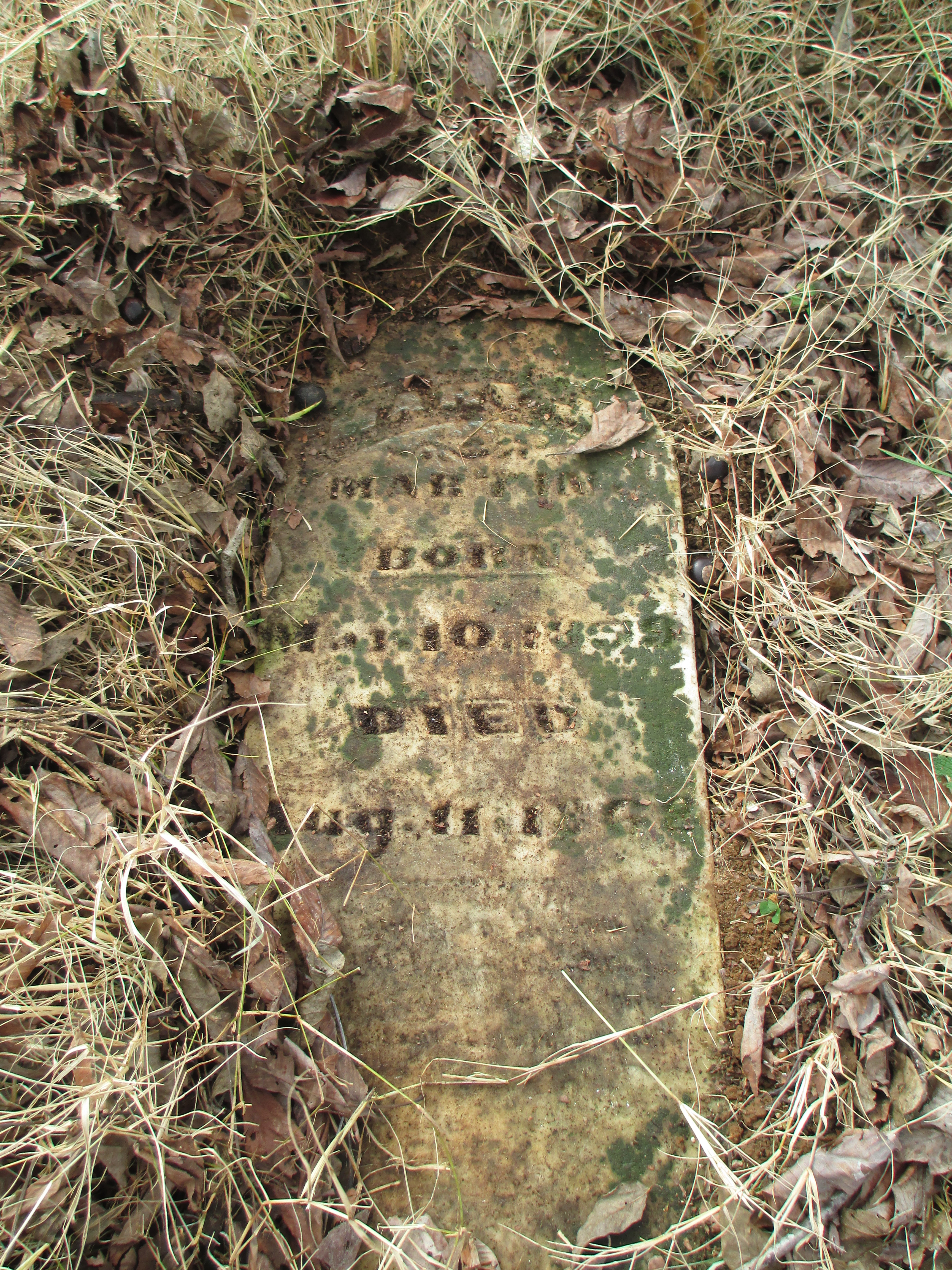
I asked Rudy if he knew where they were buried.  I understood him to say that he had never seen the graves but his father or grandfather had pointed out a place to him.  I asked him if we could go and take a look at this place.  On old Hwy 94 just south of Crabtree Rd. there is a small modern home.  It is believed to be the original home site of the John R. Roberts farm.  Rudy believed the graves might be located under a single tree to the left of this home as you face it from the road.  We made our way to the tree and saw nothing.  It sits in a spot that has been tilled in the past but on a cold day in December we saw only matted grass, flat matted grass.  Pulling back the grass we uncovered stones, several stones.  They were lying flat and in soil under the matted grass.  Some of the stones had writing.  Some were large, flat field stones with scrapes from what appeared to be tractor implements.  One recognizable name on an engraved monument stone was Mary J. Martin.  The birth date appears to be 1839 and the death date appears to be 1862.  The birth date may be 1849.  Sarah Ann “Sally” Roberts, John R. and Rebecca’s daughter, was born in 1828 and married Ivason Brooks Martin in 1847 in Williamson County, TN.  The dates don’t match her.  If the birth date was supposed to be 1849 she could be their child.  So, who is Sally J. Martin and why was she buried on the Roberts farm?

JRR1JRR 11JRR6JRR9

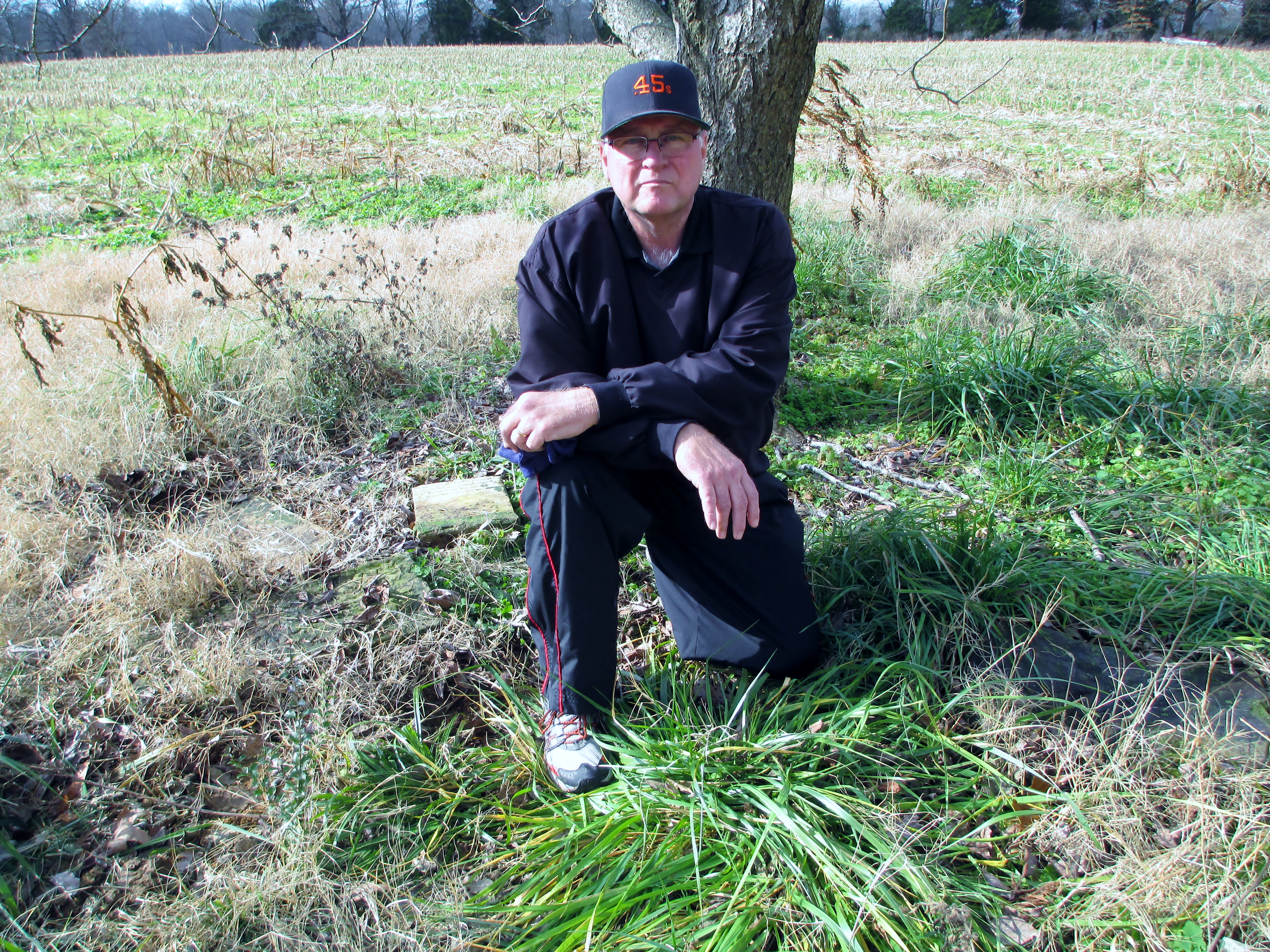
There were other flat field stones here.  Stones like you would use to mark graves.  Stones like we saw in Arrington, TN.  Kneeling beside these stones I felt connected.  I believe this to be the final resting place of John Rivers and Rebecca Ann Roberts.  For this reason alone, it will be a special place for me.

JRR12

Work needs to be done on this site and I encourage my Calloway cousins to consider if there are options to research, recover and mark this location.  (See map coordinates below.)

I want to express my appreciation to all who have assisted and added to my research.  Little gets done without people like you.  My online tree has a small part of my research and can be found on Ancestry.  My DNA results are on Ancestry and Family Tree DNA.  Follow my Roberts/Ingram/Byrd/Burns stories at:  https://backtrackingthecommon.com/

2015 GPS coordinates for John R and Rebecca Ann Roberts’ burial site

9446-9804 Kentucky 94

Murray, KY 42071

36.688823, -88.182096

Google Maps 2015

This property sits approximately 300 yards south of the intersection of Crabtree Rd. (1551) and Kentucky Hwy 94 in Calloway County.  Once you park in the drive way, look slightly to your left and there is a lone tree (2013) in the field that comes near the house place.  The gravestones are underneath that tree.  When I was there in December of 2013 they were covered over in matted grass.  This should mean this is the site of John Rivers Roberts’ old home place.

*Since publishing this post I have been able to document there are no missing years for this Newton Roberts family.

*I now believe John R. and Rebacca Ann Roberts first child Sarah “Sally” was named after John R’s grandmother who lived in Williamson County until her death.  Her name was Sarah Sammons but she went by Sally.

A Peek at My DNA Results

I sent my DNA samples off to Ancestry and Family Tree for autosomal testing in January.  While waiting for my results I hastily built a “cousin catching” online tree at Ancestry.  I received my results in March and enjoy the benefits to this day!

I plan to write a couple of full posts on DNA in the near future.  For now I want to highlight one benefit.

Autosomal DNA testing is a “family connections” type of testing.  That’s one way I think of it.  I’m told it allows you to find accurate connections to a maximum of 5 to 6 generations.  It allows you to connect on both your male and female sides.  The larger the test pool (total number of DNA contributors in any database), the more accurate the results.  I chose the two services with the largest and fastest growing databases.

My results give me a range or approximate amount of DNA compared to the known samples.  Both companies’ results were similar as you would hope they would be.  Here’s a broad overview.

I’m 99% European.  It breaks down with these approximate ranges:

  • Great Britain – Range 33% – 95% estimated at 65%
  • Scandinavia – Range 0% – 37% estimated at 16%
  • Ireland – Range 0% – 21% estimated at 9%
  • Europe West – Range 0% – 19% estimated at 6%
  • Italy/Greece – Range 0% – 4% estimated at 1%
  • Europe East – Range 0% – 5% estimated at 1%
  • European Jewish – Range 0% – 2% estimated at less than 1%
  • Caucasus Region – Range 0% – 3% estimated at less than 1%

Meaning

There’s nothing exciting here.  I’m about as white and European as you can get.  For generations now my ancestors have found and married others with genetic links to the same general part of the world.  Boring?  Those are the DNA facts and as you know in genealogy facts are good.

My DNA test results answers questions.

  • Who was my grandfather’s father?
  • Do I have Native American blood?
  • Am I related to a particular group of families?

My DNA test results help me make connections.

Some of the best fun and most productive genealogical results from DNA testing has been “meeting” so many wonderful new cousins.  They continue to add to my tree and my life.

One thing I would do different.

If I were doing it over, I would build a “cousin catching” tree on Family Tree like I did on Ancestry.  I encourage you to build a tree online and then order your DNA test.

A pleasant surprise

I wondered where my western European DNA originated and I think I found it!  I knew by the “paper trail” I’m related to the Nichols of Williamson County, Tennessee and Kerr County, Texas.   My Grandmother Emma Lee Ingram Roberts’ mother was a Nichols by birth.   I did not know until last week that through them I’m kin to the Schaffer family of South Carolina.  I found my newest and so far only sets of 5th generation great grandparents!  The paper trail clearly leads to:

Frederick Schaffer (1720 – 1786) and Maria E. Schaffer (1734 – 1787)

Johan G. Eichelberger (1729 – 1805) and Elizabeth C. Eichelberger 1740 – 1784)

The pleasant surprise?  All four were born in Germany.  Why is this pleasant to me?  Dee and I have two wonderful daughter-in-laws with clear and close German heritages (Katie and Katy).  In August we’ll add our third (Elizabeth)!  Well ladies, your husbands have always had the DNA in them.  And, by the way, 5 x great grandmother Eichelberger’s full name was Elizabeth Catherine Eichelberger!  I’m a proud great grandson and a proud father-in-law.

Thinking about DNA testing?  Build that simple pedigree tree.  Research your options.  Stay tuned.  Consider following this blog and signing up for updates.  I’ll post more on DNA in the future.

Happy hunting.

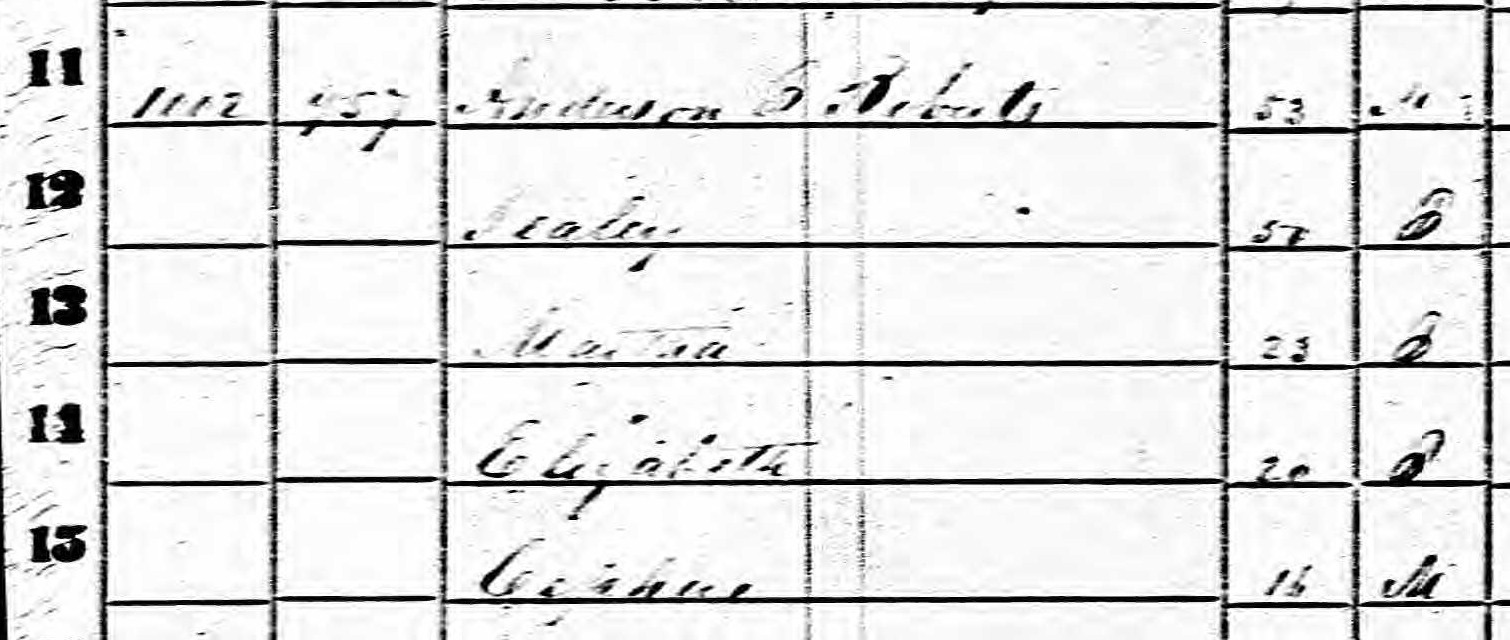
What Do You See In this 1860 Census Image?

How’s your eyesight?  What name is given for the the head of this household in the 1860 Federal Census in District 1, Williamson County, Tennessee? (The Image mirrors the quality of the original.)
1860 Roberts, Anderson G. Federal Census for Williamson County, TN

Source Citation

Year: 1860; Census Place: District 1, Williamson, Tennessee; Roll: M653_1279; Page: 170; Image: 346; Family History Library Film: 805279

Source Information

Ancestry.com. 1860 United States Federal Census [database on-line]. Provo, UT, USA: Ancestry.com Operations, Inc., 2009. Images reproduced by FamilySearch.

Original data: 1860 U.S. census, population schedule. NARA microfilm publication M653, 1,438 rolls. Washington, D.C.: National Archives and Records Administration, n.d.

Here’s what the indexer saw.

Name: Anderson F Roberts
Age in 1860: 53
Birth Year: abt 1807
Birthplace: Tennessee
Home in 1860: District 1, Williamson, Tennessee
Gender: Male
Post Office: Franklin
Value of real estate: View image

Did the indexer see it correctly?  Is it what they “saw” or could it have been “what they typed”?  Look at your keyboard next to the “F” key.  What do you see to the right?  Yes. That’s what I think this indexer did.  They made a typographical error.  They typed an “F” rather than a “G”.  They also failed to separate the Roberts family from the previous family in the column even though the original record clearly separates them.

What do we learn?

  • View the original when you can.  Don’t just take my word or the word of any other well-meaning person.  You are ultimately responsible for what you put on your tree.  Our lack of caution may confuse other online friends trying to “fill in their blanks”.  I found this relative in several other trees as Anderson F. Roberts when he is clearly Anderson G. Roberts here and in other documents.
  • Recognize your fallibility and the fallibility of others.  We all make mistakes.  Try to catch as many as you can.  Be open to correction.  We just want to get it right.
  • Take the time to put alternate information into the record when given the opportunity.  Remember, only put in what you see in the original document, not what you think or know it should be based on other research.

Can you Help!  Anderson G. Roberts is my 2 x great grand uncle.  Do you know anything about the Roberts or Tatums from Williamson County, Tennessee?  I would like to hear from you.  We may be cousins!  Also, if you enjoy this post or other posts on my blog, please share this blog with others.  You may also sign up to receive notice when new blogs are posted.  Use the “Follow” button on the Home Page.

Thanks for your help!

Dealing with Death Certificates

I love death certificates.  I sort of collect death certificates, well, at least for family history purposes.  They’re a wealth of information – and some of it is good!

Like all documents, the information contained on a death certificate is only as good as the informant. If the informant knows the correct dates, names or spellings, the document MAY be correct IF the document transcriber records it correctly.  As I wrote in an earlier post, good genealogists are good skeptics.

What can we learn about our ancestors from their death certificates?  What is the most valuable information found in these documents?  How should we approach them?  What cautions should we consider?

Consider the certificates of three brothers, three of my great grand uncles.

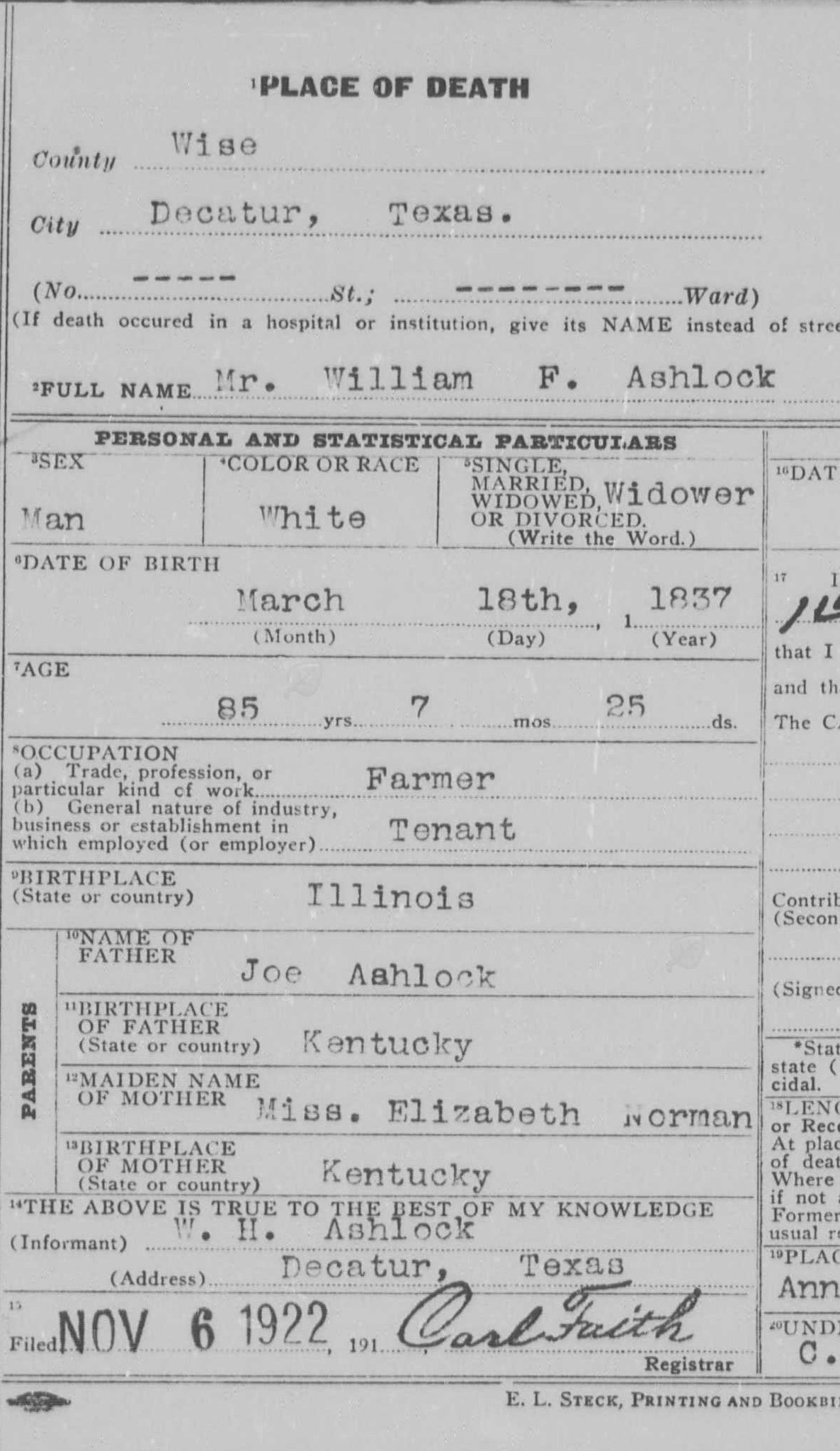
William F. Ashlock died 12 October 1922 in Wise County, Texas.  These facts and the cause of death are the most reliable facts on a death certificate.  Why?  Because they are the facts provided by an attending physician who is aware of the date, time and place of this event.  This information is found on the right side of the three samples we see here. We look here at only the left side of these samples.

1922 Ashlock, William F. Death Certificate

  • Place of death:  Decatur, Wise County, Texas
  • Name:  William F. Ashlock
  • Sex:  Male
  • Race:  White
  • Marital Status:  Widower
  • Date of birth:  March 18, 1837
  • Age:  85 yrs. 7 mo. 25 days
  • Occupation:  Farmer
  • Birthplace:  Illinois
  • Name of Father:  Joe Ashlock
  • Father’s birthplace:  Kentucky
  • Name of Mother:  Miss Elizabeth Norman
  • Mother’s birthplace:  Kentucky
  • Informant:  W. H. Ashlock
  • Address:  Decatur, Texas
  • File date and official who filed it:  November 6, 1922 by Carla Faith

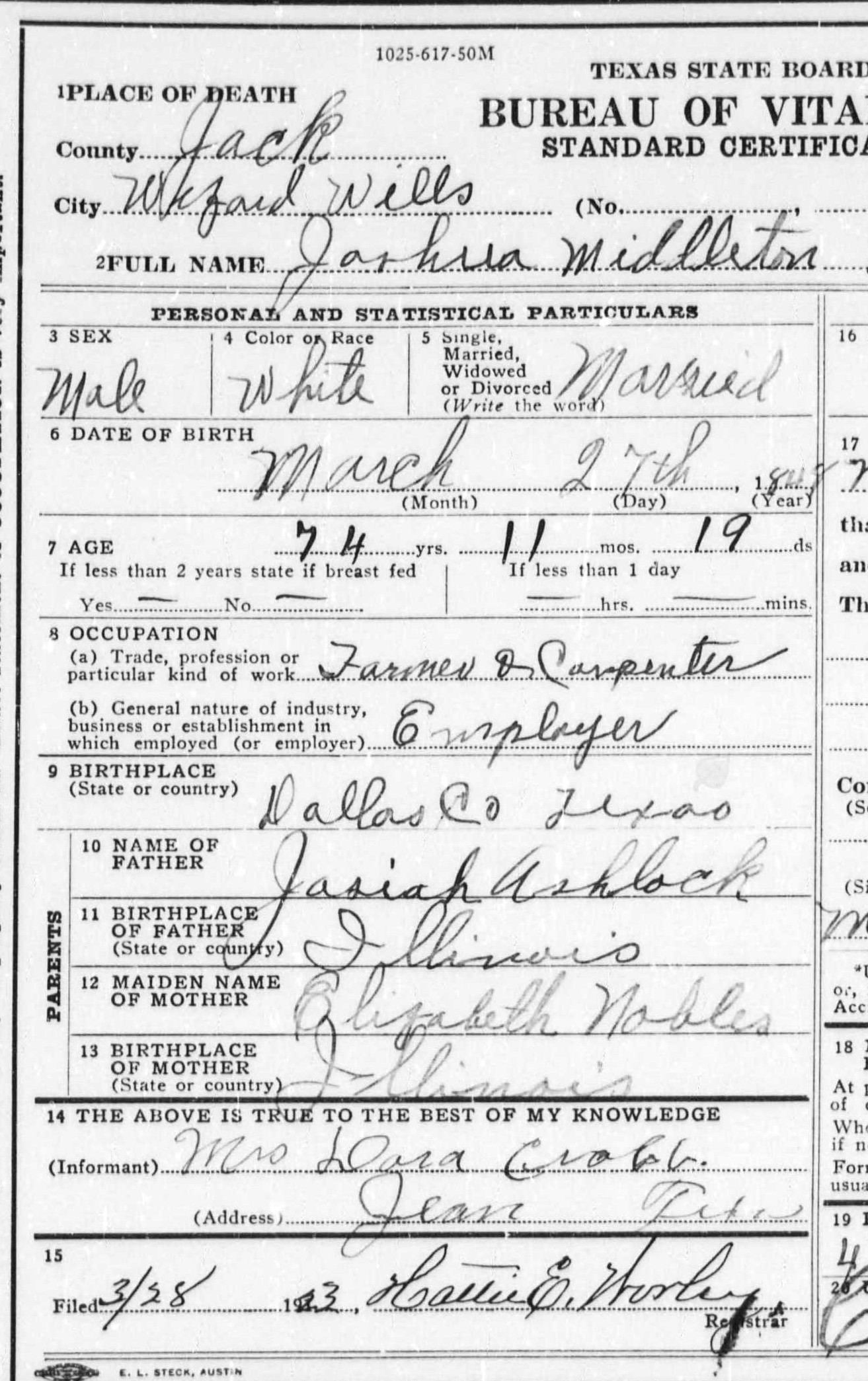
Joshua Middleton Ashlock died 17 March 1923 in Wizard Wells, Jack County, Texas.

  • 1923 Ashlock, Joshua M. Death CertificatePlace of death:  Wizard Wells, Jack County, Texas.
  • Sex:  Male
  • Race:  White
  • Marital Status:  Married
  • Birth date:  March 27, 1848
  • Age at death:  74 yrs 11 mo 19 days
  • Occupation:  Farmer and Carpenter
  • Place of birth:  Dallas County, Texas
  • Father’s name:  Josiah Ashlock
  • Father’s birthplace:  Illinois
  • Mother’s name:  Elizabeth Nobles
  • Mother’s birthplace:  Illinois
  • Informant:  Mrs. Dora Crabb of Jean, Texas
  • Information recorded by Hattie E. Worley (I think.) on March 28, 1923

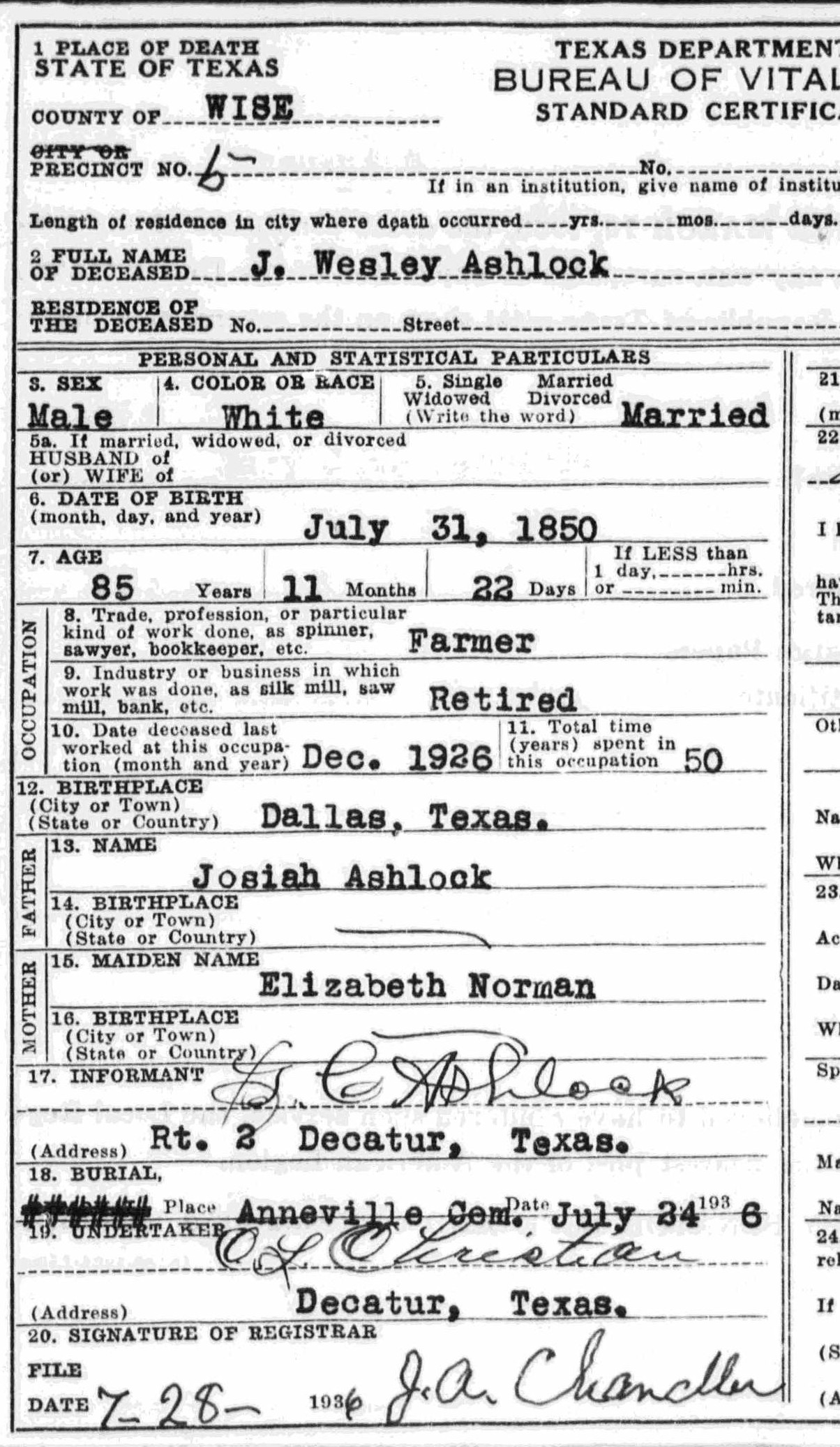
James Wesley Ashlock died July 23, 1936 in Wise County, Texas.

  • 1936 Ashlock, J Wesley death certificatePlace of death:  Wise County, Texas
  • Sex:  Male
  • Race:  White
  • Marital Status:  Married
  • Date of birth:  July 31, 1850
  • Age at death:  85 yrs 11 mo 22 days
  • Occupation:  Farmer, Retired
  • Date he last worked:  Dec. 1926
  • Years he worked at this occupation:  50
  • Birthplace:  Dallas, Texas
  • Father’s name:  Josiah Ashlock
  • Father’s birthplace:  Unknown
  • Mother’s name:  Elizabeth Norman
  • Mother’s birthplace:  Unknown
  • Informant:  G. C. Ashlock
  • Burial place and date:  Anneville Cemetery on July 24, 1936
  • Undertaker:  O.L. Christian of Decatur, Texas.
  • Filed July 28, 1936 by J.A. Chandler

Josiah Ashlock was born in 1814 in Anderson County, Tennessee.  He married my great, great grandmother Elizabeth Norman in Greene County Illinois in 1833.  She was born in Kentucky.  They began their family in 1834 with the birth of their daughter Nancy.  Their oldest son William F. arrived in 1837 followed by two daughters and a son. They arrived in Texas in about 1844 as part of the Peters Colony and settled on land along both sides of the Denton and Dallas County lines.  The original grant would be mostly north of the President George Bush Freeway east of where it intersects with with Stemmons Freeway (I – 35).  Joshua Middleton was the first of this Ashlock family to be born in Texas in 1849.  His younger brother James Wesley was born in July of 1850 also in Dallas County.  Josiah would die around 1852.  Elizabeth Norman Ashlock married my great, great grandfather Stephen Riggs.  He also had Peters Colony land surveyed in southeastern Denton County.  His first wife had died sometime before 1850.  My great grandmother Rachel Marinda Riggs would be born in Denton County in 1855.

So how did our three death certificate informants do at the death of these three Ashlock brothers?

The informant for William F. Ashlock was W. H. Ashlock.  I’m not sure who he was.  He may be a son or a grandson.  He knows his family.  He gets William’s birth date, birthplace, mother’s name and birthplace all correct.  He names William’s dad as “Joe” Ashlock.  While I can understand the 1820’s use of this name, I doubt I’ll ever find it in any official documents related to Josiah Ashlock.  He missed the place of William’s father’s birth.  All-in-all it’s not a bad performance.

The informant for Joshua M. Ashlock was Dora Crabb.  I’m not sure who she was. She gets Joshua’s name, place of birth, and father’s name correct.  She misses by one year the correct birth date.  She is also incorrect about Joshua’s father and mother’s birthplaces.  She also gives the wrong maiden name for Elizabeth.  This might confuse a well intended family historian.

The informant  for James Wesley was his son G.C. Ashlock (That’s Grover Cleveland).  He’s right about his father’s birth date, birthplace and name.  He gets his mother’s name correct.  He doesn’t know his father or his mother’s birthplace and he doesn’t guess.  He doesn’t know everything but he won’t confuse you with what he doesn’t know.

What do we learn from these death certificate examples and how we can use death certificates in our genealogy research?

  1. Death certificates are very reliable for the date and cause of death.  I will take this date of death over what is on a headstone or in a family bible.  Why?  Think about it.  Use the comment section.
  2. If the date on a death index is different from a death certificate, I’ll give more weight to the certificate.
  3. The information on any document is only as good as the informant and as reliable as the transcriber.  I like the information from an attending physician and treat everything else with less weight.
  4. What do we do with the other information on a death certificate?  Use it to corroborate other information you have.  Use it as clues on where to research next.

I love death certificates and what they provide family researchers!  I’m just a little skeptical and you should be as well.

Happy Hunting!

Samuel Byrd and the Texas Taxman

You can learn a lot from tax records.  Consider Samuel Byrd.

This Samuel Byrd was born in Tennessee on April 14, 1814.  He was the son of David Byrd and Jane Morehead.  His grandparents were Richard and Elizabeth Buster Byrd.  He (this Samuel Byrd) is one of my great, great grandfathers.  I say “this” Samuel Byrd because he’s often confused with his son Samuel Zedock Byrd (1852 – 1938) by people building online trees.  We know much about this son.  I visited his and his second wife’s grave a few weeks ago in Collin County, Texas.  I also, quite by accident, came across his first wife’s grave in a Hunt County, Texas cemetery while looking for another great, great grandfather.  His death certificate records his name as S.Z. Byrd.  There’s a good article about him and his family in a book on Collin County families.   (Collin County Texas Families, Alice Ellison Pitts and Minnie Pitts Champ; Cutis Media, Hurst, Texas; pages 69, 70.)  The article was written by Bryan Vicars, a proud family descendant.  I can’t prove some of the statements in the article (In fact, I can disprove some and doubt others.), but I do know “this” is Samuel Zedock Byrd, the son of my great, great grandfather Samuel Byrd.

I’m very interested in “my” Samuel Byrd.  I know so little about him.  I know more about his wife Elizabeth Horn Byrd.  I know a lot more about his other children.  I’ve spent considerable time trying to know him yet he remains distant and illusive to me.

Some say Samuel Byrd migrated to Texas in the middle 1850’s.  Someone reported on Find a Grave that he died September 11, 1857 and is buried in historic Pecan Grove Cemetery in McKinney, Texas.  I cannot confirm either of those statements.  The cemetery association was “officially” formed in or after 1870.  It is believed however that people have been buried in those grounds since the 1850’s.  According to land records, the land was originally owned by the McFarland and then fairly soon purchased by the Davis Family.  Both of these families previously lived in Wilson County, Tennessee before migrating to Texas.  It is believed by some that both Jeremiah and Elizabeth Horn were born in Wilson County.  Could their families, the Horns, McFarlands and Davis’s, known each other in Tennessee?

I know my great, great grandmother Elizabeth is buried in Pecan Grove.  I know her second husband Thomas Rodman is buried beside her.  I once thought my 2 x great grandfather Samuel was buried there in a vacant space on the other side of Elizabeth.  I no longer do.  Here are some reasons.

  • There is no record of his burial there. He is not in any plot records including the hand written originals in the cemetery’s safe.
  • The cemetery personnel believe someone may be buried in that vacant space but have no way of knowing who. It’s not in the records.  The plot is actually still for sale.  I give more weight to Samuel and Elizabeth’s six year old son Jeremiah David Byrd being buried there in 1861 and may explain Elizabeth’s decision to return here to bury her second husband and later have her children bury her there.  The name on those occupied plot deeds is Elizabeth Rodman dated from the 1870s.  She only purchased 2 plots when she certainly could have afforded 3 and a headstone for her first husband.  (BTW, my “abt” and “aft” date of 1855 for Samuel’s death date on my family tree is based on Jeremiah David’s 1855 birth date.
  • There are no records of any kind for “this” Samuel Byrd in the State of Texas.   No census.  No probate.  No obituaries.  No bank records.  No land records.  No tax records.  There is nothing you would expect from a man settling in to a new place…or dying!  And, I can find some or all of these for Elizabeth and her children in Texas beginning in 1860.

Death and taxes are the two certain things in life.  The tax man always cometh.  When I thought about this, I decided to firm up my suppositions with “negative proof”.  I would need to show myself there is no evidence “my’ Samuel Byrd ever arrived in Texas –  tax records.  Samuel Byrd was never to my knowledge, and I searched four likely counties, charged a tax in Texas. That means no taxes for land, occupation, income, etc.  None.

But, here’s something interesting.  I began tracking Samuel’s father-in-law Jeremiah Horn and his sons George and John’s tax records.  They began paying taxes in 1846 in Collin County and continued to pay taxes through 1857.  These included taxes on their wagons and we know they were teamsters and had a freight business.  Then in 1858, I lost them and did not pick them up again until 1860.  Why?  I don’t know.  Perhaps it was an oversight on my part.  But it wasn’t just Jeremiah, it was Jeremiah and George and John.  All three owned original survey land in Collin County.

OK, I don’t know what happened.

Here’s something I know.  In the 1860 Federal Census, Elizabeth and her children are living in Collin County near the Lebanon Post Office.  She is the head of her household and works as a weaver.  The community of Lebanon was named after Lebanon, Tennessee the previous home of many of the early settlers in this part of Collin County.  That’s Lebanon in Wilson County, Tennessee.  She lived about nine miles south of her father’s home place and about five miles west of another property once surveyed for him.  She was about nine miles north of her “missing” husband’s cousin James Byrd in north Dallas County and about eleven miles east of her son Pleasant Wesley’s future wife’s family in Denton County.

What if Samuel Byrd, yes “that” one, died in Alabama?  What if the Horns made the trip to where Elizabeth was living in order to help her, her five girls and young sons, finish crops, sale land, pack up and make the move to Texas in 1859?

I don’t know.  I really don’t.  I’m open to new documented evidence.  But here’s what I know so far…the Texas taxman never came for Samuel Byrd, but death did.


Have you ever used tax records in your family history research?  Interested?

Check out Susan Jackman’s great article on using taxes in your genealogical research.

http://www.archives.com/experts/jackman-susan/tax-records-in-genealogical-research.html

Ten Genealogical Lessons I Learned the Hard Way – New FREE webinar available for a LIMITED TIME

Here’s another great Legacy Family Tree seminar.  It’s FREE for a limited time.  Genealogist Warren Bittner shares his years of experience by sharing some of his mistakes as a researcher and how you can avoid them.  Humorous and Helpful.

Click on the link and press the “Watch Video” button.  Enjoy!

http://www.familytreewebinars.com/download.php?webinar_id=284

Hurry! Two FREE online webinars for a very limited time. Check out these free resources.

Legacy Family Tree offers free weibnars for non-subscribers on an almost weekly basis. There are presently two FREE seminars for your viewing.  Check these out.  Simply click the view button.

American Revolution Genealogy (Until the 15th)

The War of Independence changed history; our history; our families’ history. It’s a story about which we want to know more. Did my ancestor help? …even a little? There’s much to be learned about our ancestors’ roles in this moment in history. In this class, we’ll discover where to start, what the best resources are, and how to tackle the research. So, let’s go in search of answers using the soldiers’ service and pension records and unit narratives.

http://www.familytreewebinars.com/download.php?webinar_id=260

Hookers, Crooks, and Kooks – Aunt Merle Didn’t Run a Boarding House (Until the 17th)

Each of us wants to ignore that scalawag, that counterfeiter, or that madam in our family, but the black sheep may prove the most interesting of all. Learn to examine clues in unusual and also common sources. Learn how they lead to locating more records.

http://www.familytreewebinars.com/download.php?webinar_id=262

Tip #6: Decide to find the facts and not just fill in the blanks.

The internet enables incredible research and collaboration with others on your family’s history.  It’s also fraught with potential traps and misdirection.  A research mistake by you or others is multiplied.  In the past, a person took a blank family tree chart or family group sheet and filled in the blanks on paper as they researched their family.  It was a simple way to keep track of the “facts” they uncovered in their research.  If they were wrong, if they made a mistake in their research, very few people knew or were affected.  That’s not true today.

Family history is not a competition.  We may use games to teach our family history but the research we do is not a game.  When we fail in our due diligence and rush to fill in as many blanks as possible on an online family tree, we confuse and potentially misdirect others.  We may leave behind lies rather than facts for our families to follow.

This is NOT a call to abandon or stop posting online family trees.  I would never do that.  The collaborative aspect is much too valuable.  I’m appealing for accuracy in our research before we post and when we’re not sure about our conclusion to be very clear about our uncertainty.  And there lies the problem with family trees.  They are made up of names, dates and lines connecting those names and dates.  They create blanks for us to fill in and discourage uncertainty.  Family trees are not theses or dissertations.  They’re a simplified expression of that kind of research and thought.

It’s OK to leave blanks on family trees when we’re not reasonably certain what should go in those blanks.  It’s OK for others to question what we have put in our blanks.  We should welcome this.  It’s OK to change the information in our blanks.  It’s OK to use “abt” or “ca” or “unknown”.  Doing so may be better for you and others.

Here’s the bottom line.  You have to decide.  As the genealogist/family historian are you going to focus on finding the facts or filling in the blanks as fast as you can?  Will it be a competition or competent research?  If it’s competent research, you’ll be able to fill in the blanks with confidence.