I’ve Been Nominated!

Leibster AwardI’ve been nominated for a Liebster Award.  Don’t worry Mom, it’s better than it sounds.  In fact, it’s something quite wonderful.  The Liebster (from the German word for dear, beloved or sweetheart) Award is an award given to bloggers by bloggers.  It’s a pay-it-forward-way to encourage fellow writers to keep writing.  Given to bloggers with less than 200 followers (Boy can I meet that threshold!) the award’s origins are clouded in mystery.  To receive the award you must answer your nominator’s questions on your blog and then nominate three bloggers to receive the award.

Thank you Melissa from Finlay Family. org for my nomination!  Here are my answers to her questions:

1. Why did you decide to start your blog, and what is the emphasis of your blog?

Two reasons:  I wanted to use my blog to encourage me to write about my family research, to put my research in a form my family and others could enjoy.  Secondly, I was so new to genealogy and making so many mistakes that I hope to write some research tips to save other new family historians some time, trouble and money.  I focus on the four main lines of my parents’ parents and all the offshoots of these four people.  I also throw in tips for other family historians.

2. What is your favorite post that you have written? (include a link, please!)

The one I’m writing NOW about my great-grandfather’s death.  I hope to post the first installment in a few of days.  This is actually a hard question because I get excited about most things I decide to write.  I suppose “Happy Trails” was as enjoyable to me as anything I’ve written to date.

3. What goals do you have for your blog in the next year?

Like most bloggers, I would like more consistancy.  I want to research better and write better.  I want to publish at least twice each week.  I want to know my blog is helpful and entertaining.

4. How long have you been interested in your family history?

I’ve always had an insatiable curiosity, which at time has gotten me into trouble.  I’ve also enjoyed history and love the large nuclear family God gave us.  I suppose all of this comes together to “create” a family historian.  But honestly, it’s only been a little more than three years that I’ve taken a real interest in documenting our family’s past.  I think my age may have something to do with that!  I wish I had started earlier.  I wish I had asked more questions, sooner.  I’m happy I can do it now.

5. What do you enjoy most about blogging/writing?

Two things: it forces me to put into words and on “paper” the things I’m learning.  And, it allows me to leave behind something for my children and grandchildren.

6. List a few of your favorite blogs.

Here are three of my favorite genealogical blogs:

7. If you could choose any vacation destination, where would you go, and why?

When I find the origin the first Roberts in my family line to imigrate to America, I would like to go there.  And/or any place my wife wants to go is fine with me!  Good answer!

My nominations for the Liebster Award Are….

Each of these nominees easily exceeds anything I have accomplished and are worthy of your consideration.

  1. Jake Fletcher at Travelogues of a Genealogist
  2. Michelle Ganus Taggart at A Southern Sleuth
  3. Larry and Gayle at Family Roots and Branches

Should they choose to accept my nomination, they will need to post their answers to the following questions and nominate three other bloggers for the award.

  1. What are your top two motivations for blogging?
  2. Describe your early attempts at blogging?
  3. Describe your immediate family and share how, if in any way, they influence your blogging?
  4. What is the favorite blog you’ve written and please share a link to it?
  5. Describe how your research and blogging influence each other.
  6. If you had only one thing to say to your readers, what would it be?

I look forward to reading my nominees’ responses.  Congratulations!

Is DNA a genealogical miracle?

DNA imageIs DNA a genealogical miracle?  Is DNA the answer to all your genealogical problems?  No. And no.  So, why send your DNA sample off and pay someone to work-up your profile?  Because DNA is solid science and fast becoming an invaluable option in the genealogist/family historian’s toolbox.

I sent my DNA samples off last January.  I did some research first.  I decided on an autosomal test and chose two companies.  One sample went to Ancestry.com.  The other went to Family Tree DNA.  The results reached my inbox about eight weeks later within a few days of one another.  Here are some benefits I experienced in the first week of having the results:

  • Confirmed the family identity of the male DNA contributor to my grandfather and therefore confirmed my suspicion of who did not contribute DNA to him.
  • Confirmed we have yet to identify a family surname in another line of our pedigree chart. (Some researchers think they know but the DNA says it isn’t so.)
  • Confronted (and for me settled) the family lore of having Cherokee descendants in our specific family lines.
  • Confirmed my connections to cousins I met in “the old fashion way” of doing genealogy AND connected me to new cousins across America.

Sound like a miracle?  Maybe, but it’s not.

Here are some things DNA cannot do for you.

  • Build a family tree. (At least not yet!)  If you’re hoping to use DNA to breakdown your genealogical brick walls, you had better get to work on your tree!  Your DNA results may tell you you’re related by DNA to another contributor but good luck on knowing who, how, when and where without doing the hard work of genealogy.  I’m amazed at the number of people I match and they have no tree uploaded.  I can see some applications of DNA which would not need a tree but not if you’re doing genealogical/family history work.
  • Go to the library, research center or courthouse for you. Your DNA results can’t travel on your behalf and make the connections that help tell your story.  Where did the people with my DNA live?  Who were their neighbors?  When and where did these DNAs “marry”?  How did somebody with my DNA get where I am geographically?
  • Fill in the gaps and make your family history rich. Your DNA results cannot interview family members.  They cannot take you to a home place and fire your imagination.  They cannot show you a picture to put a face on that contributor.  They can’t tell you the stories of a 95-year-old great-aunt.
  • They can’t do the footwork of emailing, messaging or calling the other matches to compare notes. And if the two of you don’t have well-built trees, you may not accomplish much when you do visit.
  • They can’t interpret themselves. You or somebody else must interpret your results if you’re going to get the most out of them.  For me, this has been a steep learning curve.  I’m in my 8th month and some days feel as if I haven’t learned a thing!  DNA results 100.  Gary 0.  I like learning new things.  I like a challenge. But, honestly, I’ve got my hands full with this one.

And so you ask, would I do it all over again?  Would I spend about $100 per sample to have my DNA tested?  Absolutely!  As I write this post, I can’t wait for my sister’s mtDNA test results to come back!  It’ll be a wonderful addition to our research.  I just have to do the hard work of understanding and using the depth of knowledge and insight it provides to better tell our family’s full and fascinating story.

Here are some steps you can take if you are serious about using DNA.

  • Go online and do a search using the terms “Genealogy” AND “DNA”. Do it just like I typed it with the quotation marks.
  • Go to the YouTube site and plug in the same terms. Watch a couple of videos on the basics.  (BTW, if you’re not using YouTube in your genealogy “how to” learning, you’re missing a great tool.)
  • Now, spend some time. Do some research.  Don’t be discouraged by the complexity.  Visit with someone who loves the science and technology of it.
  • Find and read blogs specific to the subject of DNA testing. Most of the people on my Blogroll (to your right probably) have written on this subject.  Go to their blog and plug the letters “DNA” into their site search box.

Once you get your tree built, gedcom file ready to upload and DNA results available, use these two other wonderful free online tools:  Gedmatch and Genome Mate Pro.  The future is here.

Here’s how I could use your help.

  • If you have family with the surname “Roberts” who’s ancestors have lived in Lunenburg, Charlotte or Mecklenburg Counties, Virginia since the 1760s please put us in contact with one another. I’m laughing as I write this.  It sounds so crazy and presumptuous!
  • If you know a family with the surnames “Wray”, “Ray”, “Rhea”, “Whitson” or “Eagan” and they had relatives in or around Wilson County, Tennessee ca 1799 – 1840, please put us in contact with one another. (Use the comment section.)
  • And, if you have old family photos, please do not destroy them before some family member can identify them and get them up on the internet to bring joy and context to some future researcher. You may possess the only “bread crumbs” leading to your family’s past.  Treat them as treasure.

Happy Hunting!

Now, where is that Genome Mate Pro instructional video…?

Photos of the Week: ca 1906 Masonic Home for Children in Ft. Worth, Texas

Here is a remarkable photo of an early group of students attending school at the Masonic Home for Children in Fort Worth, Texas.  The photo was a gift from my cousin Suzy Cook.  It’s remarkable to us because it contains an early glimpse of no less than four of our ancestors. 

1905 or 1906 Ft. Worth Masonic Home Children (5)

Seated on the first row and moving left to right:  the 3rd little girl is my grandmother Emma Lee Ingram, my dad’s mother.  The 4th little girl is my great-aunt B.G. Ingram. The 5th little girl is my great-aunt Grace Ingram (Suzy’s grandmother).  And the first little boy is my grandfather Gus Roberts.  Remarkable and Wonderful.  That’s right, my dad’s parents met at the Masonic Home for Children in Fort Worth, Texas in about 1904.  They were only seven or eight years old at the time.  They went on to graduate High School at the Home, were married in 1918 and were together for fifty-five years!

Gus and Emma Roberts' 50thGus Lee Roberts 1916Emma Lee Ingram

Emma Lee and Gus Roberts celebrating their 50th Wedding Anniversary. Gus and then Emma the way they would have looked about the time of their marriage in 1918.  Any additional photos you have of this family would be appreciated.

John W. Vann: the man who officiated the marriage of J.C.W. Ingram and Sarah Alice Chandler

Ingram marriage document from the records of Kerr County, Texas
Ingram marriage document from the records of Kerr County, Texas accessed at the Texas State Archives in Austin.

My great grandparents J.C.W. Ingram and Sarah Alice Chandler were married in Kerr County, Texas on January 25, 1890.  The officiant was a man name John W. Vann.  His story is not common.  I thought my children or grandchildren might want to learn more about him so I’m leaving them some “bread crumbs”.  Here is a brief sketch I found on Find A Grave.

Birth: Mar. 19, 1860
Plum
Fayette County
Texas, USA
Death: Jun. 21, 1943
San Antonio
Bexar County
Texas, USA
Kerr County, Texas 1856-1976 page 232
“John W. Vann, is the eldest child of Margaret and W.W. Vann. He received his early education at Tatum’s schoolhouse in Center Point. He and Miss Blanche Weston were married before he was 21 years old. In 1890 he was elected Commissioner of Precinct No. 4 in Kerr County and served as deputy sheriff under Capt. Frank Moore. In 1892 he was elected sheriff and Tax Collector of Kerr County resigning during his sixth term to accept the position of Deputy U.S. Marshall. While sheriff of Kerr County he was twice elected president of the Sheriff’s Association of Texas.
He served as Deputy Marshall under Wm. H. Hanson at Houston and Eugene Nolte at San Antonio. Mr. Vann was appointed Collector of Customs by President Theodore Roosevelt in 1909, and stationed at Brownsville. Later he was transferred to the Department of Justice where he served as an investigator of peonage in Alabama, Florida and Texas and is still in government service there. Mr. and Mrs. Vann reared four children at the old home place north of town. Walter, Stewart, Mrs. Amy Wallace and Charles.”Book D Kerr Co, District Court July 3, 1911
Blanche Vann vs John Vann
…….It is therefore ordered, adjudged and decreed by the court that the bonds of matrimony existing between the plaintiff Blanche Vann and the defendant John W. Vann be and are hereby dissolved and annulled and the plaintiff Blanche Vann divorced from the defendant John W. Vann. It is further ordered and decreed by the Court that the defendant pay all costs in this behalf expended for all of which let execution issue.January 10, 1920 Kerr Co, TX
Vann, Mrs. Blanche age 56 divorced b. TX dressmakerJanuary 28, 1920 San Antonio, Bexar Co, TX
Vann, John W. age 60 b. TX special agent-railroad
Vann, Maud A. (wife) age 33 b. EnglandApril 7, 1930 St. Anthony Hotel, San Antonio Bexar Co, TX
Vann, John W. age 70 divorced b. TX deputy marshall-govt service”Family links:
Parents:
Wilson Wade Vann (1835 – 1906)
Margaret Laduska Bishop Vann (1839 – 1924)

Siblings:
John William Vann (1860 – 1943)
Mary Ann Vann Burney (1862 – 1950)*
Murray Wilson Vann (1864 – 1918)*
Josephine Ellen Vann Caldwell (1872 – 1943)*
Etta Vann Wright (1872 – 1961)*
Thomas S. Vann (1875 – 1950)*
Maggie Mae Vann Brown (1878 – 1950)*
Edna Blanche Vann Spruill (1880 – 1962)*
Bishop Lafayette Vann (1883 – 1958)*

*Calculated relationship

Burial:
San Jose Burial Park
San Antonio
Bexar County
Texas, USA
Created by: Cathy Morgan
Record added: Aug 26, 2011
Find A Grave Memorial# 75504519
John W. Vann with his wife Blanche and children William and Amy

I am grateful to Find A Grave, Cathy Morgan and others who have contributed to this memorial.  I’m also indebted to the West Kerr Current and especially Irene Van Winkle for the photo of John W. Vann and family.  This is how he would have appeared at about the time of my great-grandparents’ wedding.

Finding Jeremiah Horn…or Where did they put my 3rd great-grandfather?

Genealogists and family historians ask questions, lots of questions.  When and where were they born?  Who and when did they marry?  What were their names and when were their children born?  When did they die and where are they buried?  The answers to these questions outline a life once lived.  They tell a story.  That story is somehow incomplete if we can’t answer the last question.

My quest began with my mother saying something like, “I don’t know.  He was a Byrd and some say a prominent Methodist minister in Wise County.  He’s in a book there in the library.”

We were talking about her grandfather, my great-grandfather, whom she did not know.  He died 18 years before her arrival on the planet and for whatever reason(s) the family knew little about one another.  I did not grow up spending much time with extended family.  Part of my interest in family history is to connect my children and grandchildren to their roots.

I entered and exited childhood in the Dallas/Ft. Worth metroplex.  Born in Ft. Worth, I lived in Arlington and Euless before moving to Denton to attend 2nd grade and eventually graduate High School.  We saw my dad’s parents and sister’s family the most, though that was not very often.  We saw my mom’s brothers Charles and Loal Byrd and their families a few times.  My dad did not know the name of his dad’s dad until I told him three years before his death in 1988.  We weren’t very connected and from my point of view, not very curious as a family.

Imagine my surprise 40 years after high school to discover I had dozens of relatives buried within easy driving distance of Denton.  Some of them had been in North Texas since Texas was a Republic.  Some had fought in the War of 1812, some in the Mexican-American War and some in the Civil War.  Two of my 3rd great-grandfathers had original Texas land grants with the Peters Colony.  One was in Denton County (!) and the other one was next door in Collin County!  One of my 3rd great-grandmothers had an original land grant located mostly in Dallas County with about a fourth of it in Denton County.  And, my 3rd great uncle, James Byrd, owned over 1800 acres in today’s north Dallas.  640 acres of that was an original Peters’ land grant.  He died in California during the gold rush but his wife and many family members are buried in north Dallas within a 35 minute drive of where I played baseball as a child.  I drove across one of their grants playing football in Carrollton.  I drove across another one of these original land grants every time I drove from Denton to Dallas on Interstate 35.  I drove by a third one every time I took Hwy 380 east to or through McKinney, Texas.  And I’ll tell you I followed that “trail” many times.  Stop today at the new Taco Bueno across from the new Walmart on Hwy 380 East and you’re there.  You’re on part of Jeremiah Horn’s original land grant!  Who knew?

It was a natural progression and gradual revelation.  Find my grandfather Byrd’s father.  Pleasant Wesley Byrd was in fact a well-known Methodist minister in Wise County, Texas.  Hwy 380 West traverses this county traveling west out of Denton.  He was in fact in a book in the library.  Got him.  Find his father.  Samuel Byrd was a bit more elusive and remains so.  But, I found him.  His wife, my 2nd great-grandmother Elizabeth Horn, “introduced” me to her father JeremiahHis story is not so common.  Now, where did they put him?

As stated, you’d like to tie up all your genealogical quests with a nice bow.  Have a birth date and place, etc. and put a period on it with a “spot”.  You want to know.  Where is the victim, I mean loved one, buried?  Where did they put him/her?  (It dawns on me that the growing popularity of cremation in our culture is going to drive future family historians crazy!)

I began my online search for Jeremiah Horn’s burial place in 2012.  I was so pleased 1867 Horn Family Cemetery Gateand pleasantly surprised to rather quickly find the Horn Family Cemetery just west of McKinney.  As you can see in the picture, it even had the year of Jeremiah’s death on the gate.  He must have been the “first in”.  However, it wouldn’t be THAT easy.  Jeremiah Horn’s body is not planted in this place.  In fact, the two well-known Horn families in Collin County have not been able to genealogically connect their families.  This in spite of the fact they both had family in Wilson County, Tennessee prior to their arrival in Texas and before that, in North Carolina.  How could they not be connected?  But, that’s another quest for another year.  Now, where was I?  Oh yeah, where did they put Jeremiah?

Jeremiah Horn was said by some online seekers to be buried in the Hunt Cemetery.  And somebody, somewhere wrote or said the Horns and Byrds first came to Hunt County, Texas near the Collin County line and then on to Collin.  I was surprised again.   The Hunt Cemetery of Collin County is on the opposite side of the county and south of the community of Rheas Mill making it closer to the Denton County line than the Hunt County line.

Photo by Will and Shelly about 2005

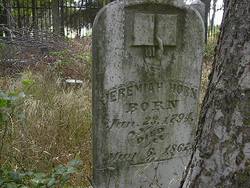
I found the Hunt Cemetery on MapQuest.  I found it on Find A Grave.  I found a record of the deed for the cemetery land.  On a trip to North Texas I looked for the cemetery.  I could not find it.  I showed the location to my sister.  When she and her family had moved back to North Texas from Arizona they bought a home within a few miles of the cemetery!  Incredible.  Jeremiah Horn’s resting place was there all the time.  Using her phone’s GPS she located the cemetery in a grove of trees on private property (on the original Horn land grant).  When she asked the family’s permission to visit the cemetery, they did not even know it was there!  It was overgrown and a storm had blown down many trees sometime after these first photos were taken.  But she found it!

Photo on Find A Grave

I visited the site the next winter.  Boy Scout Troop 289 and the Prosper Historical Society had taken on the cemetery as a project.   They cleaned, cleared the area and reset the stones that were down.  It was beautiful.  They are to be commended.

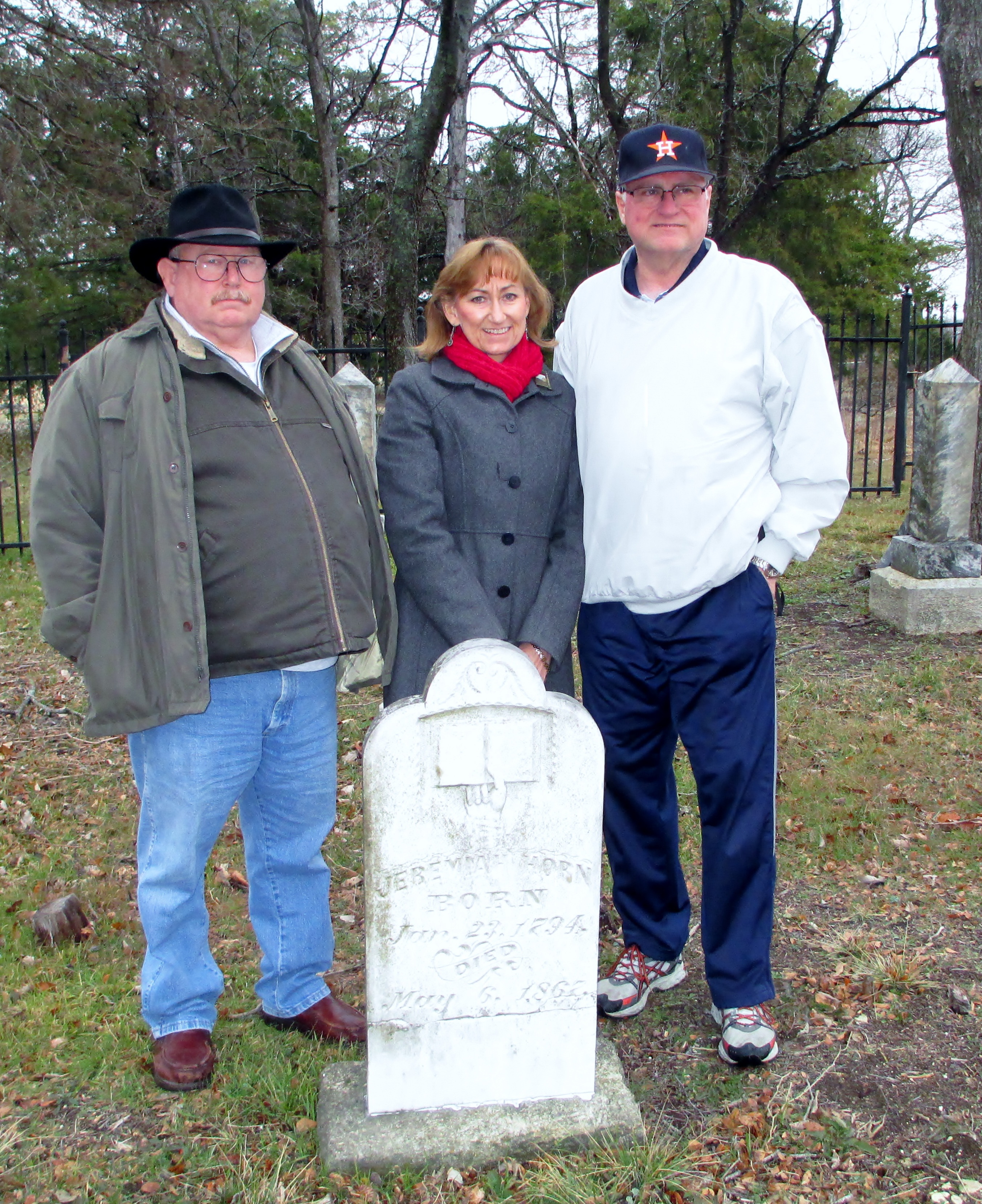
The children of Bertha Mae Byrd Roberts: David Roberts, Debbie Scroggin and Gary Roberts
The children of Bertha Mae Byrd Roberts: David Roberts, Debbie Scroggin and Gary Roberts at the grave of their 3rd Great-grandfather Jeremiah Horn in 2014

Here are the GPS coordinates, latitude: 33.22940, longitude: -96.73310. Please ask permission before driving across the land owner’s pasture to get to the cemetery.

Find a Grave says there are fourteen graves identified in the cemetery.  I count sixteen.  One of them is my 3 x great-grandfather Jeremiah Horn.  I found his burial site.  I can “put a period” on his story. But of course, Jeremiah Horn has many more tales to tell.

Happy hunting!

Photo of the Day: Alice Davies and Suzy Cook

IMG_5230

That’s Suzy Cook with her mother Alice Davies.  Alice is the granddaughter of Sarah Alice Nichols Chandler Ingram and the daughter of Grace Ingram Mohn.  She’s my great-aunt and she’s 95 years old!  Doesn’t she look great?  Thanks Suzy and Aunt Alice!Sarah Alice Ingram

My great-grandmother Sarah Alice “Sally” Ingram (1861 – 1942)


Methodists Among the Cherokee

Jeremiah Horn was a Methodist or should I write, “a methodist”.  In the beginning he was not a Methodist by denomination, but by conversion.  He was a methodist by personal experience.  Those who followed the Wesley brothers methods of holiness and devotion, and who brought the gospel into the American wilds, made an impact on his life.  Some of these men were part of other groups but all were “methodists” in their practices.  He named one of his sons Charles Wesley Horn after the famous preacher. He named another son after the influential Methodist minister mentioned below, James J. Trott.  Jeremiah became driven by his own call to preach Christ and did so vigorously.  To our knowledge he had little formal education.  He worked with his hands to provide for himself and family and preached when he wasn’t working (and sometimes when he was!)

Jeremiah Horn ministered in Cherokee Nation East as early as 1818.  He voluntarily moved to Indian Territory in the west  in 1834 as part of the early removal of the Cherokee.  He would be named in that year by the Methodist Conference (now you can read “denomination”) as their missionary to the Cherokee.  By 1846 he was in Collin County, Texas as part of the Peters Colony.  He went on to establish churches and “ride the circuit” while running a farm, blacksmithing and hauling freight with his sons.  He died in 1867.

Below is a quote concerning Methodist missions among the Cherokee people in the early days.

Methodist Missions

With their uneducated but caring circuit riders and their “four-day” or protracted camp meetings that resembled Cherokee all-night dances and extended camping, Methodists converted more Cherokees than all the other denominations combined. Their Arminian approach minimized atonement and the recognition of saints. Salvation was an open door, and sinners had free wills. In 1823 the first circuit riders were appointed in Tennessee near the site of John Ross‘s home, south of Chattanooga. Their emphasis was not on model farms and boarding schools but rather on itinerant and emotional ministry.
However, the Methodists, yielding to Cherokee wishes, did open six-month day schools at Oothcaloga and Pinelog, along with semipermanent churches: barely literate but enthusiastic, the main ministers were Richard Neely, Nicholas D. Scales, Dickson C. McLeod, and James J. Trott, all of whom married Cherokee women. Within four years Methodists accepted Cherokees as licensed preachers and traveling exhorters, among whom were Young Wolf, Turtle Fields, John Spears, William McIntosh, and John Fletcher Boot. In 1829 Methodism achieved a milestone when the church admitted the Ross brothers, John and Lewis, as members; the former had a home at New Echota. By 1830 Methodists had claimed more than 1,000 members.

(From New Georgia Encyclopedia Online)

Jeremiah Horn would have known all of the men mentioned in this article.  He may have been related by marriage to more than one of them.  Keep following the clues…

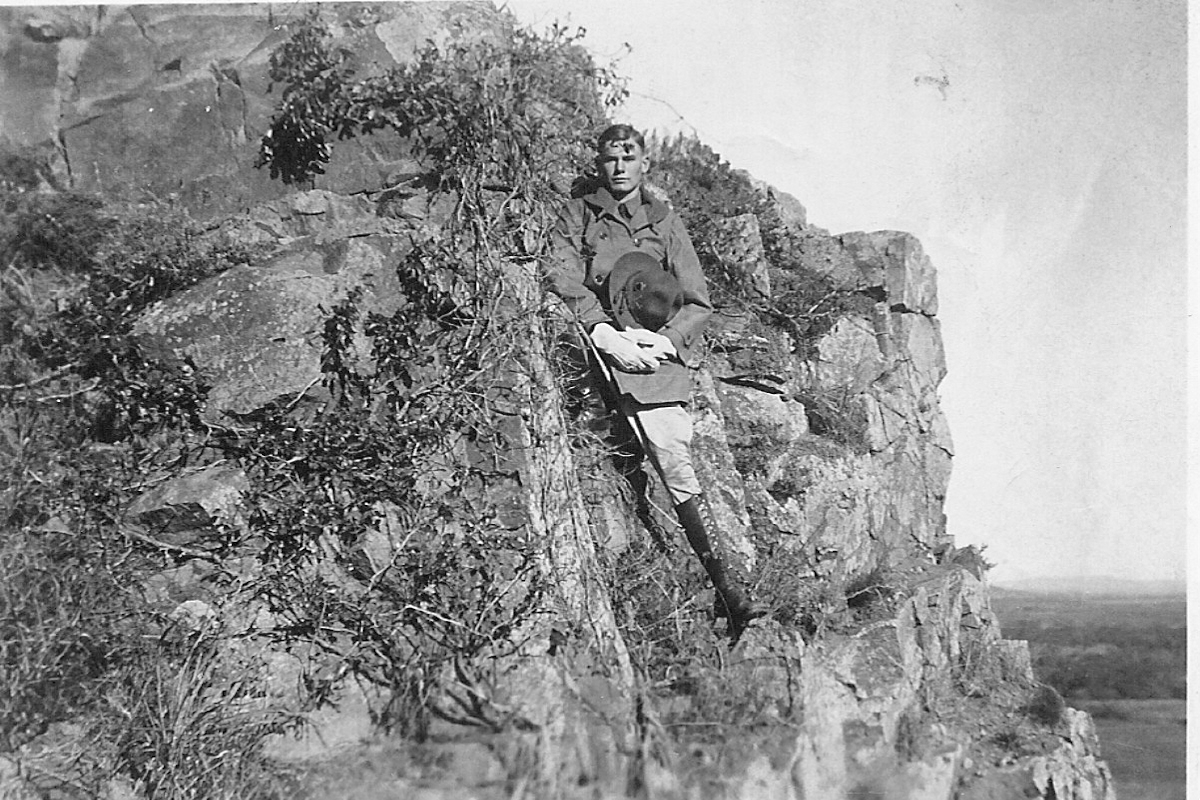
Burton Lee Roberts ca 1938

Burton Lee Roberts ca 1938 near Fort Sill, Oklahoma.  Dad joined the Army Air Corp in 1935.  He served as a DI for the 26th General Hospital Group's military training in 1941.  He then joined the unit and trained with them in their hospital/medical training eventually serving in North Africa and Italy during WWII.
Burton Lee Roberts ca 1938 near Fort Sill, Oklahoma. Dad joined the Army Air Corp in 1935. He served as a DI for the 26th General Hospital Group’s military training in 1941. He then joined the unit and trained with them in their hospital/medical training eventually serving in North Africa and Italy during WWII.

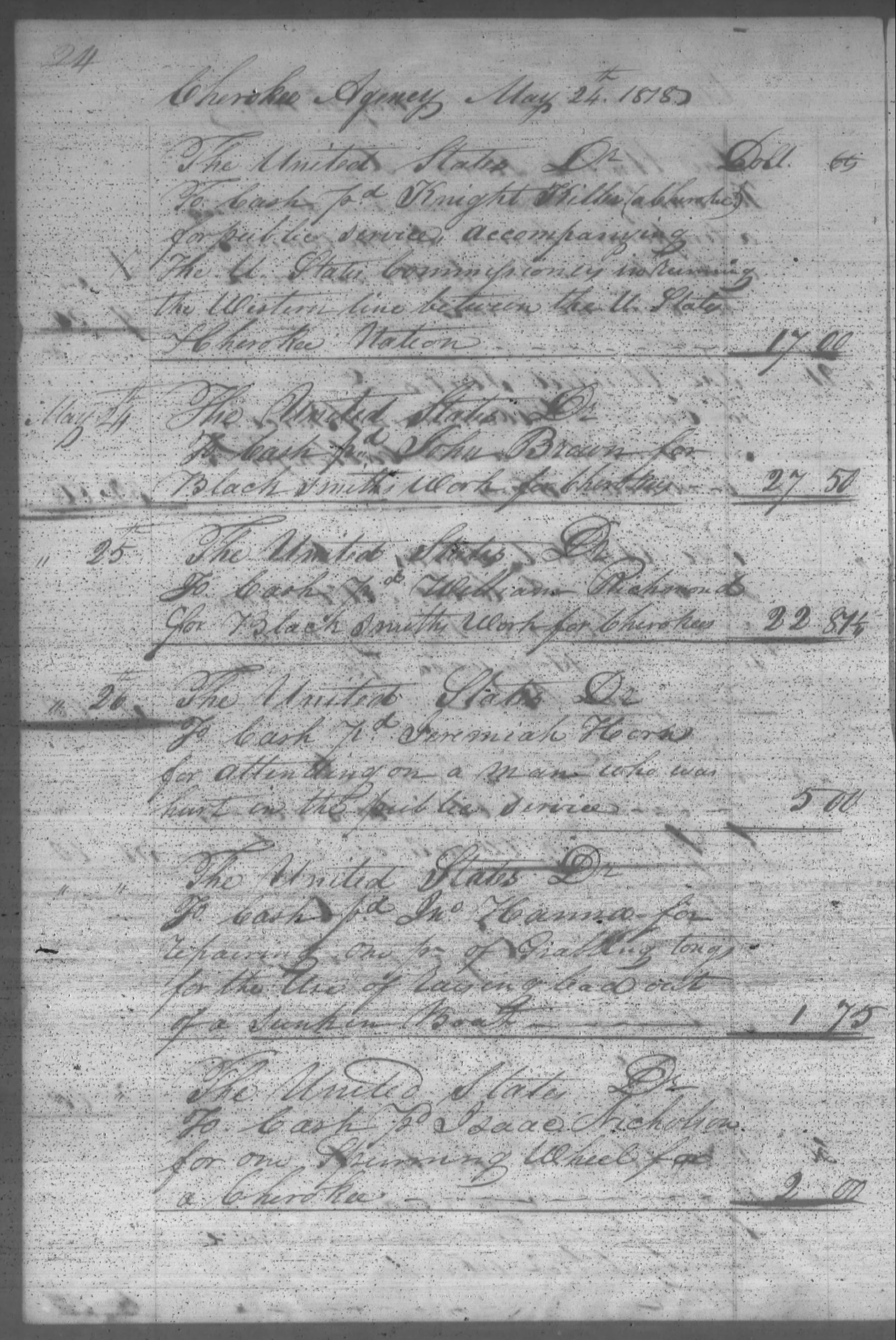
Today’s Document: 1818 Cherokee Agency Payment Record

1818 Horn, Jeremiah Cherokee Agency record from May 24

What:  A partial record of payments paid out by the Cherokee Indian Agency.

When:  May 26, 1818.  This was a Tuesday.  Other historical records (Cherokee Council Records) inform us there is a council meeting of the Cherokee chiefs and warriors at the Agency on this day.  This Council began on the 20th of May and would conclude on the 28th.  Governor McMinn revealed to the Cherokee leaders the U.S. government’s’ intent to move all Cherokees west.

Who:  Jeremiah Horn receives a payment from the Agency.

Where:  Agency Creek on the Hiwassee River, Cherokee Nation.  This is the second location of the agency and was located here from 1816 – 1821.  This would be in present day Meigs County, Tennessee named after the agent Return Jonathan Meigs.

Transcription:

” ” 26   The United States ___ To Cash pd Jeremiah Horn for attending on a man who was hurt in the public service.     5.00″

Significance

  1. Confirms Jeremiah Horn’s presence in Cherokee Nation no later than the 26th of May 1818.
  2. Informs how early he may have been aware of the U.S. government’s intent concerning the Cherokee people.
  3. May reveal something about the person Jeremiah Horn.

Questions:

  • Can you fill in the blank in the transcription?
  • What do you believe this document says “about” Jeremiah Horn?

Source:

Citation Information

Detail

Page 27 – Cherokee Indian Agency (TN)

Web Address

https://www.fold3.com/image/205282655/

Source Information

Title

Cherokee Indian Agency (TN) at Fold3

Repository Information

http://www.fold3.com

Happy Trails: Finding surprises in my research

It’s always a happy coincidence to cross the trail of an ancestor while tracking an entirely different prey.

My dad’s mother and father met at the Masonic Home for Children in Ft. Worth, Texas in about 1905.  They would marry after their graduation from high school at the home in 1916.  It’s doubtful they ever knew their families had crossed paths 100 years earlier in Williamson County, Tennessee.  It’s doubtful anyone knew…until now.

Gus Lee Roberts 1916
Gus Roberts portrait done in about 1917

Gus Roberts was born in Lamar County, Texas in 1898.  His father, John Anderson Roberts was born in Williamson County in 1830.  If you do the math he was nearly 68 years old when my grandfather Gus was born by his second and much younger wife Mary.  He was the only child of this union.  John A. or “Jackie” as he was known, died in 1901.  I doubt Gus had many memories of him and would have certainly not remembered any stories of his origins.  Gus would be raised as an orphan.  (That’s another story for another time.)  John Anderson’s story was very different.  His father’s name was John Rivers Roberts.  He was born in Virginia but arrived in Williamson County as a very young boy in or before 1804.  All of his children would be born in Williamson County and all seven which are known to us would survive to adulthood.  Their place was on Rutherford and Flat creeks.  John R would be the last of the males in his family to leave the county of Williamson, waiting until after the death of his mother in about 1857.  The majority of them would migrate to Calloway County, Kentucky.  His father is known simply as John Roberts.  I call him “My John Roberts” because I don’t know his middle name and I can’t find his father.  He was born in Virginia and arrived in Williamson County by 1804.  He is in the 1805 tax list.  He and Rebecca’s first children, like John R., were born in Virginia.  They would go on to have other children born in Williamson.  He died in the county in November of 1823 and I believe he is buried on the old original Roberts home place somewhere near the headwaters of McCrory Creek.  I wish I knew where.

Emma Lee Ingram Roberts

Emma Lee Ingram was born in Dimmit County, Texas in 1898.  She had a twin who did not survive the birth.  Like her future husband, she was the offspring of her father J.C.W. Ingram’s second wife.  JCW would die in October of 1902 leaving nearly four year old Emma fatherless.  Emma’s mother was named Sarah Alice Nichols when she was born.  Most people knew her, like her namesake aunt, as “Sally”.  She was born in Tennessee in 1861 (Although she is often confused by Ancestry tree builders with some Nichols in Arkansas).  I believe she was born in Williamson like her older siblings but concede it could have been Marshall County.  Her father Frederick Shaffer Nichols, however, was most certainly born in Williamson in September of 1834.  He would eventually migrate to the Hill Country of Texas and die in Kerr County in 1896.  Emma would never know her grandfather.  Frederick Shaffer’s father Allen Frederick Nichols was born in Newberry, South Carolina in 1787.  He and his family were in Williamson before 1816 when his son Andrew was born.  Allen Nichols appears on the same tax records as my 3rd great grandmother Rebecca Roberts and two of my 3rd great Roberts uncles Newton and Anderson (my great grandfather’s middle name namesake).

And so there they are.  Two kids meet in a children’s home in Ft. Worth, Texas without knowing their families had crossed trails and no doubt travelled the same trails 100 years earlier in Williamson County, Tennessee.  The county “marked” both sides of my father’s family and perhaps his family helped shape the county in some small way.

But, that’s not all.  My 2nd great grandfather Frederick Shaffer Nichols married Sarah Elizabeth Neely in Franklin, Williamson County, in 1854.  This was Sarah Alice “Sally” Nichols mother and the grandmother of Emma Lee Ingram, my grandmother.  Sarah Neely’s father was named William L. Neely and was born in Williamson County in 1804.  His father, my 4th great-grandfather, was named James Neely and was born in Virginia in 1783.  He died in Williamson in 1833.  The Neely family was somewhat prominent and influential in the county and spilled over into the northern part of Maury County (Goodspeed histories mention them and their descendants in both counties).  You can find their “fingerprints” all over various records in Williamson County.  There is this one in particular that surprised me.

My 3rd great-grandfather John Rivers Roberts married Sarah B. Smithson before he married my 3rd great-grandmother Rebecca Anna Giles.  John R. and Sarah had two sons together, Clement Smithson Roberts and James S. Roberts.  Sarah may have died giving birth to James in 1825.  Sarah’s father, Clement Smithson, had previously died in Williamson in 1814 when she was about eleven.  His death and subsequent probate produced a considerable number of document pages which continued growing all the way through the 1849 court session!  (It was timber rights and land values based on land and timber on land sold following her father’s death.)  Sarah was a beneficiary and her name appears in those earliest documents and on through and including her sons’ names and her surviving husband John R. as their representative.  And found in the early days of these documents there is the signature of one of the appraisers of the estate in 1815.

James Neely 1815 signature

That’s right.  It’s the 1815 signature of my 4th great-grandfather James Neely on a Smithson/Roberts probate record!

And that’s not all.  William O. Smithson was born in Williamson in 1831.  He married Mary Jane Nichols who was born in the county in 1838.  Yes, that’s the same Smithson and the same Nichols families.  This couple and their family migrated to North Texas, then the Hill Country of Texas (Kerr and Kendall Counties) and then back to Montague County in North Texas.  Just this week the management responsibilities for Mary Jane’s Find A Grave memorial was passed to me.

I’ve only just begun to really look at the Neely family.  I haven’t said much about my Giles family of Williamson and Maury Counties.  I’m sure I’ll find many more connections.  I’m also researching the remarkable number of all family connections between Lunenburg County, Virginia and Williamson County, Tennessee.  If you’re researching families in Williamson and lose their trail, look in Lunenburg, Charlotte and Mecklenburg counties, Virginia first for their ancestors.

Emma Lee Roberts with Debbie & Gary
My sister Debbie Roberts Scroggin and me with our “Nanny”

It’s always exciting for me to “strike” the trail of an ancestor as I backtrack the common.  It’s especially exciting to see those trails intersect and at times merge with the trails of other DNA contributors.

Happy Trails!

(This, as with most of my backtracking work, is dedicated to my grandchildren.  GFR 2015)

https://backtrackingthecommon.com/